Tag Archives: The Ambitious Madame Bonaparte

Writing Historical Fiction: Researching Period Furniture

The following photographs are pictures I took of period furniture displayed in the Maryland Historical Society. During the writing of the novel, I had to do a lot more research than this, but it gave me start.

bed and bed steps

Notice that the bed steps open up to reveal a potty seat — for when nature calls in the middle of the night. (I seem to be pursuing a theme this week!)

sidechair

Bejamin Latrobe designed this chair for Dolley Madison to use in the drawing room of the President’s Mansion. (It wasn’t called the White House until after the War of 1812.)

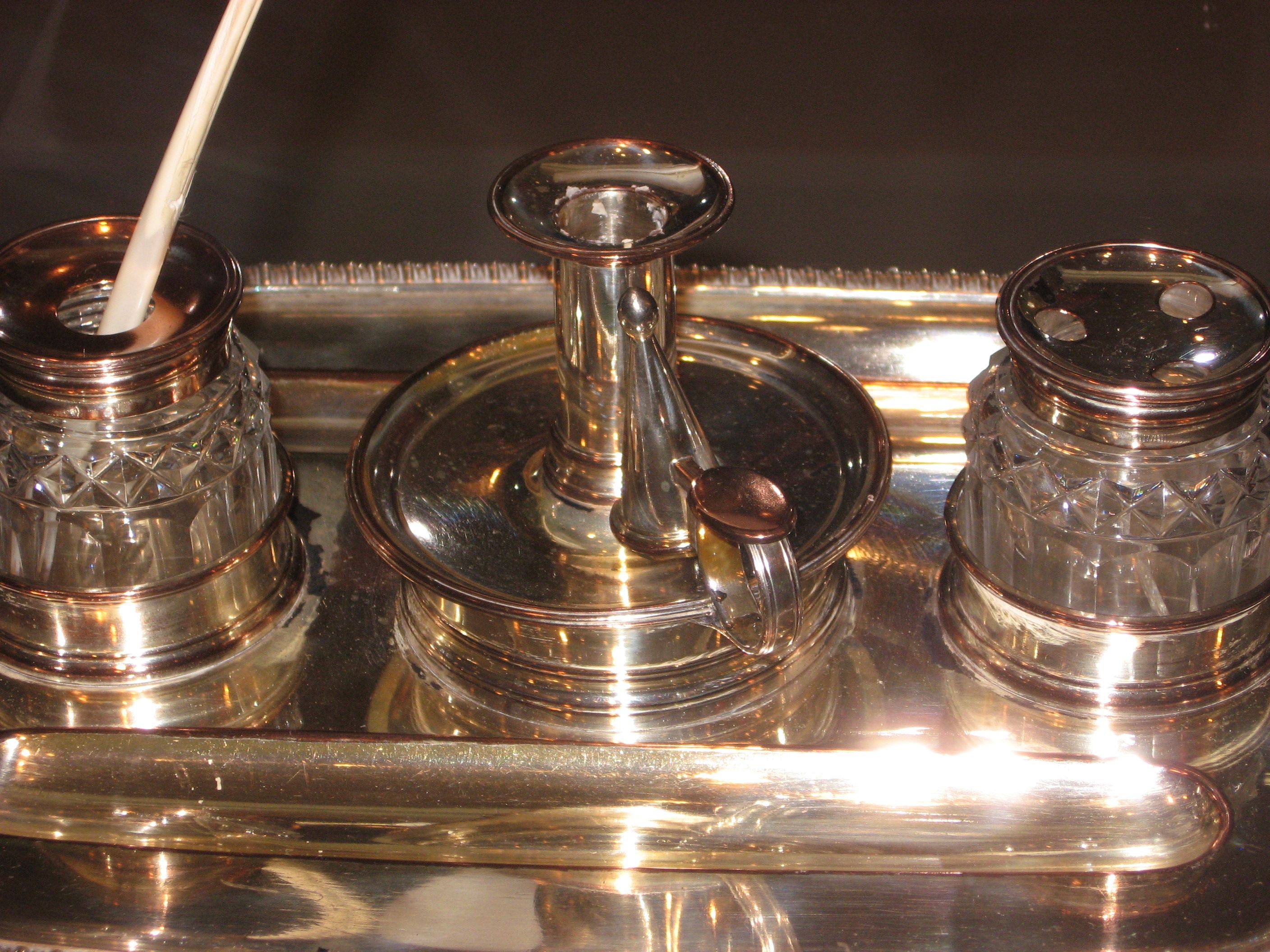
inkstand

Charles Pinkney, U.S. Attorney General, used this inkstand to write a draft of the declaration of war against Great Britain in 1812.

dresser

I didn’t use anything like this particular piece of furniture in the novel, but I love the exuberance of this dressing table. The figures on the upper doors represented Commerce and Industry.

armchair

This armchair inspired me to choose teal upholstery for the furniture Betsy’s parents had in their drawing room.

couch

I love the color combination on the Grecian couch. It helped me to realize that the color palette from Betsy’s time period wasn’t quite as somber as I might have assumed.

8 Comments

Filed under Uncategorized

19th Century Life: Bodily Functions

Two years ago when I was visiting Baltimore for research, my husband and I toured the Homewood House Museum. Homewood was the mansion of Charles Carroll, Jr., son of Charles Carroll of Carrollton (the only Catholic to sign the Declaration of Independence). Today, Homewood is beautifully restored, decorated, and furnished to authentically represent how it originally looked. It’s located on the campus of Johns Hopkins University, and I strongly recommend visiting it if you’re ever in Baltimore.

Elizabeth Patterson Bonaparte almost certainly attended parties at Homewood in its heyday. Not only were the Pattersons and Carrolls both leading Maryland families, they were also intimately connected. In 1806, Betsy’s older brother Robert married Charles Carroll, Jr.’s niece, Marianne. So Homewood was a must-see for me. The day we visited, I told the woman who was going to be our guide that I was there to do research for a historical novel, but I did not name my subject. I was scrupulous about keeping that information private until I finished my manuscript.

As we toured the mansion, our docent led us into a room they have furnished as Mrs. Carroll’s dressing room. Almost directly in front of where I was standing was what looked to be a small, low mahogany table with slender neoclassical legs. Set within an arch-shaped opening in the “table” was a recessed silver basin. (You can see it in the third image on this page.) The docent announced in a somewhat amused voice that this piece of furniture was a bidet that had once belonged to Betsy Bonaparte. The docent didn’t elaborate—and because I was keeping my special interest in Betsy a secret—I didn’t press her for information. I must admit that I had a very difficult time keeping a straight face.

You see, up until that moment, I hadn’t really thought about Betsy in terms of her bodily functions, so unexpectedly encountering her bidet was disconcerting. It turned out, however, to be enormously helpful to me as a novelist, because it allowed me to think of her in an earthier way. She became more of a flesh-and-blood woman to me than just a hazy historical figure.

After we returned home, I did some Internet research and found an article originally published in the Baltimore Sun (Rath, Molly, “You Never Know What Will Turn Up Among the Collectibles at the Maryland Historical Society,” November 20, 1994). According to that article the silver basin in the bidet was inscribed with the name of Napoleon’s own silversmith. I can only assume that Jerome gave it to Betsy after they married—or bought it for their home.

The article also mentioned that Betsy carried a porcelain bourdaloue with her when she traveled. A bourdaloue is basically a fancy, French porta potty shaped something like a gravy boat—a handy thing to have for those long 19th-century carriage rides. I find it difficult to imagine Betsy hiking up her skirts and taking a tinkle in a public coach, but maybe she used it in the shrubbery during stops along the way. And she and Jerome did travel extensively in their own privately owned coach and six, so theoretically, she could have used it there.

Both the bidet and the bourdaloue were left to the Maryland Historical Society (MdHS) by Betsy’s grandson. At first, the curators at MdHS didn’t realize what the bourdaloue was. Thinking it was an extra large sauce dish, they put it on display as part of a table setting—until a porcelain expert enlightened them about its true function.

Since Betsy was known for her sharp sense of humor, I feel certain she would have been amused.

205 Bourdalou mit Blumenmalerei Frankenthal c1756-1759
A Sample Bourdelou (not Betsy’s), Photograph by Austin Towers, via Wikimedia Commons

11 Comments

Filed under 19th century life

Characters Who Speak a Foreign Language, Part Two

My post on foreign language dialogue Tuesday sparked a conversation in the comments with another writer about the subject—a conversation that reminded me of another technique I used in The Ambitious Madame Bonaparte. This technique doesn’t indicate that someone is speaking in another language; rather, it shows that a speaker has an accent. Rather than alter the spelling of English words to indicate that, I played with word order based on what I knew of the character’s first language. Here’s an example of what I mean:

I have a scene where a ship is being refused admittance to the port at Amsterdam:

As the boat turned back, the old Dutch pilot slapped his forehead. “Verdomme! Idioot!” He snatched the salt-stained cap from his head and wrung it between his hands.

“What is wrong?” Captain Stephenson demanded.

“Three weeks ago, a notice I read describing this ship and forbidding us from guiding her. Now, Jezus Christus, I will be hanged unless my age and bad memory they excuse.”

Just a hint of this can go a long way toward making a speaker sound foreign, and it’s much less phony than writing something like “Tree weeks ago, a notice I ret tescribing dis ship,” etc.

5 Comments

Filed under Writing Historical Fiction

Writing Historical Fiction: 19th c. Information Lag

While I was planning the plot of The Ambitious Madame Bonaparte, I had to deal with what I call information lag. In the current age of instant communication, it’s hard to remember how long it once took for news to travel.

In the early 1800s, it took a day to travel the 45 miles from Baltimore to Washington. It could take four days to go from Baltimore to New York. Not only were the travel times long, but mail was not secure. Travelers sometimes amused themselves by opening and reading packets of letters that were in transit.

The times for transatlantic travel were obviously much worse. An exceptionally fast ship could make the crossing in three weeks, but six weeks to two months was more typical. As a result, information lag had a huge impact on the love story in my novel.

Think about it. You’re a lusty young man, impulsive by nature, who is accustomed to using your position as Napoleon’s brother to get what you want. On a brief visit to the United States, you meet the most beautiful, witty girl you’ve ever encountered. You know your brother would expect you to ask him before you decide to marry, but frankly, you’re tired of being treated like a child—and it’s obvious that you have many rivals for the young woman’s hand. Would you want to wait four months for a ship to cross the Atlantic and back again to find out what your family thinks of your choice? Especially knowing that the letter might be lost and you’ll have to start all over again six months from now?

No, I didn’t think so.

Although I’m sure it was exasperating to Betsy and Jerome, as a writer, I was grateful for the information lag because it helped to add considerable tension to the plot. The specifics of how that tension plays out will not be revealed until the book is published. (That’s my contemporary version of information lag.)

vigilante

8 Comments

Filed under Writing Historical Fiction

Writing Historical Fiction: Foreign-Language Dialogue

Although the first part of The Ambitious Madame Bonaparte is set in the United States, one of my main characters is European. Jerome Bonaparte’s first language was Italian, and his second was French. Betsy had studied French from an emigré when she was a schoolgirl, and her lifelong dream was to live in France, so it only made sense to assume that the two of them spoke French to each other quite often.

The problem is that many of my readers won’t know that language. So how does a writer tackle this issue? I took a variety of approaches.

One tactic is to write the dialogue in English but to say that it was said in French, as in the following example:

The two young men were speaking in French and, apparently assuming that Americans could not understand the language, spoke at full volume even though their comments were far from discreet. Betsy, who had learned French from Madame Lacomb, heard one of them say, “Bonaparte, I think the young lady before us is the one whom Mlle. Pascault described, the girl called the Belle of Baltimore. Certainly, I have not seen anyone else who fits the description.”

A second tactic is to sprinkle the text with small phrases that are either well known or similar enough to English that they are easy to figure out:

Pardonnez moi.” Jerome bowed, sweeping his arm elegantly to one side.

A third tactic—and this one is my favorite—is to plant context clues in the surrounding text, so the reader won’t feel lost even if they don’t understand exactly what the characters are saying:

Jerome lowered his voice. “Je rêve du jour quand je te présenterai à Napoléon. Il verra que j’ai choisi un femme aussi élégante que Josephine.

Although Betsy felt gratified that Jerome would compare her favorably to Josephine, she could not allow him to assume their marriage was a certain thing.

Because a large part of Betsy and Jerome’s story concerned the interaction between and comparisons of two different cultures, I wanted their dialogue to show that. These three techniques allowed me to accomplish that goal.

12 Comments

Filed under Writing Historical Fiction

Preparing for Publication

Exciting news, at least for me. I just entered a new stage of getting The Ambitious Madame Bonaparte ready for publication.

Stage One occurred earlier this summer when my editor completed his first review of the manuscript. I spent a couple months this summer working on a revision, and then I sent it back to  the publisher on August 31.

In the meantime, the book designer and I have been emailing back and forth about the typeface, chapter openings, scene breaks, and cover design. All of those pieces are coming along well. I guess we could call that Stage Two, even though it overlapped  with Stage One.

Today, we begin Stage Three. The editor just sent me his copy edits for the first 100 pages of manuscript. He promises a steady stream of chapters throughout the coming week. I have to go through and review each of his suggested edits and make the final decisions.

Once I finish that, the manuscript will be out of my hands for a while as the layout / production work is done. Last, the designer and I will have two sets of proofs to review.

But that’s enough looking ahead. For now, I have plenty to do responding to the copy edits.

10 Comments

Filed under Publishing

Betsy Bonaparte: Her Venomous Tongue

According to people who knew her, Betsy Bonaparte had a quick wit and a sharp tongue. One of the amusing aspects of portraying her in the novel was allowing her to rebuke her foes with stinging insults that I would never dream of using myself.

One acquaintance who wrote about her was James Gallatin, son of Albert Gallatin — who was the Secretary of the Treasury and later the Minister to France. When Betsy was in Paris, she dined with the Gallatins often. In his memoirs, James Gallatin recorded the following story. I wasn’t able to use it in the novel, so I will quote it here:

[Madame de Staël] had given a dinner at her house in Geneva, to which Madame Bonaparte was invited. Arriving very late, she delayed serving the dinner for over half an hour. On one side of her was a Mr. Dundas, a great gourmand, who was much put out at having to wait. After the soup had been served he turned to Madame Bonaparte and asked her if she had read the book of Captain Basil Hall on America. She replied in the affirmative. “Well, madame, did you notice that Hall said all Americans are vulgarians?”

“Quite true,” calmly answered Madame Bonaparte, “I am not in the least surprised. If the Americans had been the descendants of the Indians or the Esquimaux there might have been some reason to be astonished, but as they are the direct descendants of the English it is perfectly natural that they should be vulgarians.” After this Mr. Dundas did not open his mouth again and left at the first opportunity.

The Diary of James Gallatin

4 Comments

Filed under Extra Tidbits

Betsy Bonaparte: More than a Pretty Face

Betsy&Dorcas

Dorcas Spear Patterson and her daughter Elizabeth by Robert Edge Pine, c. 1786, Maryland Historical Society, Photograph by Ruth Hull Chatlien, 2011

As a young girl, Betsy Patterson loved to read, and she enjoyed showing off her quick mind. One book she savored was the Maxims of the Duke de La Rochefoucauld—a collection of more than 500 sayings. La Rochefoucauld was a French aristocrat who had lived during the 1600s. His maxims were insightful, cynical, pragmatic, and sometimes scornful. It seems an odd choice of literature for a young girl, yet something in it spoke to Betsy. By the time she was ten, she had diligently memorized each saying. As I was writing the novel, I had fun having her recall maxims that were appropriate to what was happening in her life during various periods. To give you a sample of La Rochefoucauld’s outlook, some of the maxims I didn’t quote in the book are listed below:

We are never so happy or so unhappy as we suppose.

Great names degrade instead of elevating those who know not how to sustain them.

We always like those who admire us, we do not always like those whom we admire.

We may bestow advice, but we cannot inspire the conduct.

In a time when many children memorized psalms, this was the view of the world that shaped young Betsy’s consciousness. One of the many things that made this woman distinctive.

6 Comments

Filed under Extra Tidbits

Betsy’s Circle: Joshua Barney

Joshua-barney-circa-1800
Sketch of Joshua Barney, c. 1800, Wikimedia Commons

As I mentioned yesterday, the man Jerome visited in Baltimore was Joshua Barney, a naval officer. Barney was born in Baltimore in 1759, and he served in the U.S. navy during the American Revolution. During that war, he was taken prisoner several times and then exchanged for British officers. In 1779, he was captured again and imprisoned in England. He escaped in 1781, and the next year, as commander of the ship Hyder Ally, he captured the much more heavily armed HMS General Monk.

After the American Revolution, he served in the French navy for a while, which is probably how he met the Bonapartes. Barney returned to the United States in 1800. During the War of 1812, he served first as a privateer and then rejoined the U.S. navy as a captain.

In June 1814, Barney’s flotilla encountered a British fleet in Chesapeake Bay. The British pursued the U.S. vessels, which retreated up the Patuxent River and then up St. Leonard’s Creek, which was too shallow for the British frigates. The British blockaded the mouth of the creek so the Americans could not escape. Rather than allow the British to capture his flotilla, Barney scuttled the ships.

Two months later, he took part in the defense of Washington and was severely wounded, taking a ball in his thigh—which could never be removed and which troubled him the rest of his life. He died in 1818 of complications from that old wound. He was only 59.

Leave a comment

Filed under Extra Tidbits

Writing Historical Fiction: Back Story

Jérôme Bonaparte - Sophie Lienard
Jerome Bonaparte by Sophie Lienard, on Wikimedia Commons

What brought Napoleon Bonaparte’s brother Jerome to Baltimore of all places? Well, for one thing, Baltimore was the third largest U.S. city in the early 1800s, behind New York and Philadelphia. It was one of the country’s most important ports.

Second, a year or so earlier, Napoleon had decided that his baby brother was going to become the naval expert of the family. Accordingly, Jerome was made a lieutenant (even though he was technically too young) and sent to the West Indies. While there, he made a colossal error of judgment that might have had serious international repercussions, so his commanding officer ordered him to return home to report to his brother, who at the time was First Consul of the French Republic.

Britain and France were technically at peace during 1803, but relations between the two countries remained uneasy. French officials were understandably nervous about exposing a member of Napoleon’s family to possible danger should war break out again while he was en route. They decided Jerome should go to a U.S. port and sail on a neutral ship—and thus, hopefully, escape the notice of the British navy.

So Jerome went to Baltimore, where his friend Joshua Barney lived. Being a young man who loved amusement and pretty girls, Jerome decided to enjoy himself while he was there. He soon began to hear about a beautiful young woman named Betsy Patterson, known as the Belle of Baltimore, and grew eager to meet her. From all accounts, Jerome had a way with young women, but he never took any of his amours seriously. I’m guessing he thought he could have a fling and then be on his way with little consequence to himself. However, Betsy proved to be more than a match for the charming young Corsican. When they met, he was instantly smitten. As the saying goes, the thunderbolt struck, and any interest Jerome had in returning home disappeared.

2 Comments

Filed under Writing Historical Fiction