The Manuscript Is Done

Essentially, that was the message I heard from my editor yesterday.

I’ve input all the changes I want to make in The Ambitious Madame Bonaparte based on the copy editing. I read it through. I sent my editor a long email discussing my evaluation of the book and the fact that it fulfills the goals I had for this particular project.

He wrote back expressing his opinion, which corroborated mine. The one thing that surprised me is that he suggested that I let it sit a couple of days and read it through one more time to make sure that nothing “clanks” in my ear. I was eager to send it on to the designer, but I think his counsel is wise.

I have such ambivalent feelings about letting the manuscript go. The last two years plus of living with these people has been very intense, and now I’m going to be done tinkering with their lives. I hope that Betsy, wherever she is, feels that I’ve told her story well. That was my goal when I started this project, to portray her tumultuous life in all its complexity, not to let her be a caricature or a symbol of any kind.

I don’t have children, so I’ve never had the experience of sending one of my babies out into the world . . . until now. As my editor said in an email the other day, the manuscript is about to go beyond the reach of my protection. If I’ve done my job right, I’ve imbued it with enough strength so that it can stand on its own.

This is the most famous portrait of the real Elizabeth Patterson Bonaparte, painted by Gilbert Stuart. Look at the bust on the left. Can’t you just see her saucy personality? That was one thing I’ve tried to capture in my book. It will be up to my future readers to determine if I succeeded.

Elizabeth-Patterson-Bonaparte_Gilbert-Stuart_1804Elizabeth Patterson Bonaparte by Gilbert Stuart, 1804

9 Comments

Filed under Publishing

Assassinations Attempts and Their Aftermath

Saturday, I described one of the assassination attempts on Napoleon Bonaparte. There were two others that I know of. On Christmas Eve 1800, royalist plotters planted a wagon with a bomb, known as an “infernal machine,” along the route that Napoleon was going to take to the opera. Napoleon was running late that evening and ordered his coachman to drive more quickly than expected, so he passed by before the explosion occurred. Reportedly, more than 50 people were killed or wounded by the device.

In 1804, the French police received word that royalists were plotting once again to overthrow Napoleon. The report implicated the Duc d’Enghien, a young prince of the house of Bourbon, which had ruled France before the Revolution. Most historians today believe that, although there was a plot, the report about Enghien was false. But at the time, Napoleon acted on it immediately. He sent French dragoons secretly across the Rhine into Baden, arrested the duc, and brought him to France for a trial. Enghien was found guilty and executed by firing squad within a week. The affair of the duc d’Enghien incensed the rest of Europe. Napoleon had violated the sovereignty of another state to take Enghien prisoner, and the trial and execution were conducted with unseemly haste. The affair gave Napoleon’s enemies damning evidence to support their claims that he was an upstart tyrant.

The discovery of the plot had an equally dramatic effect on Napoleon. He became paranoid that he would be killed and all that he had accomplished would be undone. So he agreed with minister of police Joseph Fouché that the only way to prevent future such attempts was to change the consulate into a hereditary empire, with Napoleon as the emperor. That way, even if Napoleon should die, his heirs would continue to rule.

Five years later, the assassination plot of Friedrich Staps caused Napoleon to reach an equally momentous decision. He loved his wife Josephine, but she was already in her mid-forties and had proven unable to give him a son. Still worried about the stability of his empire should he be killed, Napoleon decided to divorce Josephine. He formed an alliance with Austria, which until then had been one of France’s bitterest enemies, and married the Archduchess Marie Louise. She was a member of one of the great royal houses of Europe and trained to do her duty. She was also, apparently, sensual. The only thing reported about their wedding night is that after the relationship was consummated, she turned to Napoleon and said, “Do it again.” (At least, that’s what Nappy claimed later.) Whether that story is true or not, she did accomplish her purpose and in a year, gave Napoleon a son.

Marie Louise Empress

Empress Marie Louise by François Gérard, via Wikimedia Commons

7 Comments

Filed under Extra Tidbits

This Date in History: October 12, 1809

At the beginning of the French Revolution, most European nations were shocked by the the events in France and considered it appropriate to try to restore the French king to his throne. It goes without saying that all those other countries had monarchy in some form or another. However, by January 1793, Louis XVI was dead. The execution of the Bourbon king only intensified international opposition to the idea of a republican France. In 1793, Austria, Great Britain, Prussia, Spain, and the United Provinces of the Netherlands formed a coalition to oppose both the French government and the spread of revolutionary ideas to their own lands.

Over the course of the next 23 years, France was almost continuously at war, and in all probability, the only thing that kept it from being defeated at an earlier date was the military genius of Napoleon Bonaparte. Napoleon’s leadership was a double-edged sword, if you’ll forgive the pun. His brilliant victories defeated Austria and kept Britain at bay time and time again. However, after he became First Consul in 1799 and  emperor in 1804, the other rulers of Europe viewed him as an upstart and a usurper, and they adopted the goal of defeating him at any cost. It became a vicious no-win situation for Napoleon. He felt that he had to use his leadership and military skills to keep his country safe, yet he became one of the primary reasons his country was being attacked.

Which brings me to October 12, 1809. By this time, the Allies had formed not one, not two, but five coalitions to defeat France. The Fifth Coalition essentially fell apart when Napoleon trounced the Austrians. France and Austria negotiated a treaty to end the war at the palace of Schönnbrunn in Vienna. While this was going on, a seventeen-year-old German named Friedrich Staps decided to assassinate Napoleon to bring an end to his rule. Staps entered the palace grounds on October 12 while Napoleon was viewing a military parade and tried to approach the emperor. One of Napoleon’s aides found the young man suspicious and had him arrested, and a knife was found to be hidden on his body. Under questioning, Staps admitted his plans. When Napoleon asked if he would be grateful for a pardon, Staps declared that he would still try to assassinate Napoleon anyway. A firing squad executed Staps on the 17th.

It was not the first attempt to assassinate Napoleon, and such attempts on his life only made him more obdurate in pursuing his goal to build a French empire. He greatly feared what would happen to France if he should die without a clear succession plan in place. After this attempt, he took decisive action that I will discuss in my next blog post.

Schloss Schoenbrunn Gloriette

Schönnbrunn Palace, via Wikimedia Commons

2 Comments

Filed under This Date in History

Betsy’s Circle: Germaine de Staël

Laugier de Stael

Anne Louise Germaine Necker, baronne de Staël by Jean Nicolas Laugier, via Wikimedia Commons

One of Betsy’s literary friends was Germaine de Staël, who was a colorful and controversial figure on the European scene.

She was born Anne-Louise-Germaine Necker to Swiss parents in Paris in 1766. Her father was a Genevan banker who became Louis XVI’s finance minister. Like Betsy, she exhibited the qualities of wit, intellectual curiosity, and lively conversation as a child. She was married at the age of twenty to Baron Erik de Staël-Holstein, the Swedish ambassador to France. It was not an affectionate marriage but gave her status as the wife of a diplomat.

Madame de Staël first gained literary fame by publishing Letters on the Works and Character of J.-J. Rousseau in 1788. According to Encyclopedia Britannica, her work exhibited a “mixture of Rousseau’s enthusiasm and Montesquieu’s rationalism.” Despite the Revolution, she remained in France until 1793, and then she moved to England to be with her lover, Louis de Narbonne, who had been one of Louis XVI’s ministers.

After the Reign of Terror ended, she returned to Paris and began the most illustrious stage of her career. She alternated between living in Paris and at her chateau in Coppet, Switzerland. Madame de Staël held a noted salon, where intellectuals could converse about important ideas of their day, and she published several essays. She also took a new lover, the politician and writer Benjamin Constant, who introduced her to German romanticism.

Madame de Staël wrote two novels, Delphine and Corinne, that were infamous in their day because they exposed the limits imposed on independent and creative women. Napoleon disapproved of her work—he was a traditionalist in his views of women’s roles. As a liberal, Madame de Staël opposed him politically, so that deepened his dislike. In about 1803, Napoleon exiled her to a distance of at least 40 miles from Paris. During the remainder of his reign, Coppet was her home base.

In 1810, she published her most important work, a study of German culture. She returned to Paris after Napoleon’s downfall, but lived only a few more years, dying in 1817.

Leave a comment

Filed under Extra Tidbits

Writing Historical Fiction: Relinquishing Control

This week, I am finishing the copy edit review of The Ambitious Madame Bonaparte and will soon send it back to my publisher for design and production. I find myself having mixed feelings. I am happy with the book, and I believe that with my editor’s help, I have made it a far better book than it was a few months ago.

Yet, I know that once this pass is over, my ability to make substantial changes to the manuscript will end. During the proof review, I’ll be able to fix any remaining typos and grammatical errors, but it won’t be appropriate to do intensive rewrites. Whatever shape the manuscript is in at the end of this week will be the condition in which it goes out into the world. My baby is moving beyond my control.

This will be the first time I’ve experienced this phenomenon to this extent. I’ve worked in educational publishing for 24 years, and I’ve had short stories, poems, and one non-fiction YA book published before this, but not a novel. Unlike any project that came before, this book has taken two years of my life. Sending it out feels like a deeper level of vulnerability than I have ever experienced. I have waited thirty years for this day to come, but I never really thought about what it would feel like. The important thing to remember is that even with something that means so much to me, I don’t have to be perfect. I only have to do the best I am capable of at the time—and I think I can honestly say that I’ve done that.

10 Comments

Filed under Publishing

Bonaparte Family Album

This is one of my favorite portraits of Jerome Bonaparte. I could imagine falling in love with this guy—or at least getting a serious crush on him. Usually when I needed to write love scenes between him and Betsy, I’d look at this for a while to get in the mood.

Jérôme Bonaparte - Sophie Lienard

by Sophie Lienard, via Wikimedia Commons

And I love this portrait of Napoleon because he looks so young and intense in it. Actually, he was 34 when it was painted, but to me, he looks like he’s in his early twenties. It has a very different character from the portraits made just a few years later with all the imperial trappings.

Bonaparte premier Consul Gérard Chantilly

A Portrait of Bonaparte, First Consul by François Gérard, via Wikimedia Commons

This is a portrait of their mother.

Robert Lefèvre 001

Portrait of Letizia Bonaparte by Robert Lefévre, via Wikimedia Commons

And I’ll repeat the scandalous portrait of Pauline I showed a few weeks ago.

Pauline Bonaparte 2

Portrait of Pauline Bonaparte by Robert Lefevre, Image from Wikimedia Commons

4 Comments

Filed under Research

19th Century Life: Literature of the early 1800s

One of the many reasons Betsy wanted to live in Europe was to take part in literary society. It’s difficult to imagine this now, but two hundred years ago, there really wasn’t such a thing as American literature.

In contrast, British literature was flourishing.

The Scottish poet Robert Burns had published his poems in 1786. Perhaps the best-known is “To a Mouse,” with this famous stanza:

But Mousie, thou art no thy lane,
In proving foresight may be vain:
The best-laid schemes o’ mice an’ men
Gang aft agley.
An’ lea’e us nought but grief an’ pain,
For promis’d joy!

It’s usually translated into English as follows:

But little Mouse, you are not alone,
In proving foresight may be vain:
The best laid schemes of mice and men
Go often awry,
And leave us nothing but grief and pain,
For promised joy!

PG 1063Burns Naysmithcrop

Robert Burns, by Alexander Nasmyth, via Wikimedia Commons

In England in 1798, William Wordsworth had published his Lyrical Ballads, and Samuel Taylor Coleridge first published The Rime of the Ancient Mariner, which has these famous verses:

Day after day, day after day,
We stuck, nor breath nor motion;
As idle as a painted ship
Upon a painted ocean.

Water, water, every where,
And all the boards did shrink;
Water, water, every where,
Nor any drop to drink.

Gothic novels, such as The Mysteries of Udolpho by Ann Radcliffe (1794) were just beginning to be published. This would become a popular genre in the following decades.

France and Germany, too, had a wealth of literature during that time period.

In contrast, what did the United States have in the way of accomplished writers? Well, during the late 1600s, a couple of Puritans named Anne Bradstreet and Edward Taylor had published beautiful devotional poems. Here is one of the most well-known of Taylor’s stanzas:

Make me, O Lord, thy spinning wheel complete.
Thy Holy Word my distaff make for me.
Make mine affections thy swift flyers neat
And make my soul thy holy spool to be.
My conversation make to be thy reel
And reel the yarn thereon spun of thy wheel.

Although their poetry is still admired today, I doubt that their works had much appeal for Betsy. She was decidedly worldly in her tastes and interests.

Portrait of Washington Irving by John Wesley Jarvis in 1809

Portrait of Washington Irving by John Wesley Jarvis (1809), via Wikimedia Commons

In 1802, Washington Irving began to publish the first of his satirical essays. I can easily imagine Betsy reading and enjoying those. However, there really was not much else for an American with literary interests to take pride in. Irving’s fiction would not appear for nearly two decades, and the works of Hawthorne, Melville, Emerson, and Thoreau would not be published until mid-century.

And perhaps most astonishing to me of all, in my research I discovered that New York City probably had only one theatre!

Once she arrived in Europe, Betsy was able to attend salons where intellectual ideas were discussed and meet famous writers and artist. She even became close friends with a few well-known women writers. I’ll talk about a couple of these later this week.

4 Comments

Filed under 19th century life

19th Century Life: American vs. European Cities

One question that my early test readers of The Ambitious Madame Bonaparte asked me was why Betsy wanted to live in Europe so badly. What did she have against her own country?

In our current time period, when the United States is the most powerful country in the world and U.S. culture is a dominant global force, it’s hard to realize what the country was like two hundred years ago. The difference between living in an American city and living in a European capital was like the difference we’d experience between living in small-town Wisconsin and Chicago.

Look at the two graphs below, which I created using statistics I found on the Internet.

european cities 1800

U.S. cities

To further drive home the difference, here is an image of Paris in the early 1800s:

Place des Victoires by Victor-Jean Nicolle

Place des Victoires by Victor-Jean Nicolle, via Wikimedia Commons

And here is the description I wrote in the novel of Washington, D.C., in 1804:

The next day, Aunt Nancy took Betsy and Jerome on a carriage tour. After Congress had decided in 1790 to build the nation’s capital in a newly created federal district, President Washington commissioned civil engineer Pierre Charles L’Enfant to devise a plan. Originally from France, L’Enfant wanted to construct a city in the European style with important buildings set far apart to allow for public gardens and plazas. At the time of Betsy and Jerome’s visit, the wide spaces between public buildings were occupied by a mix of uncleared land, small plots with cabins, and recently built houses—giving the city of Washington the disconcerting appearance of a sparsely settled wilderness with a few grandiose structures set down at random. Stories abounded of Congressmen going squirrel hunting within the city or getting mired in a swamp as they drove to their quarters at night.

Betsy was clever, ambitious, and interested in art and literature. Is it any wonder she wanted to be in Europe where the action was?

6 Comments

Filed under 19th century life

Artifacts of a Life

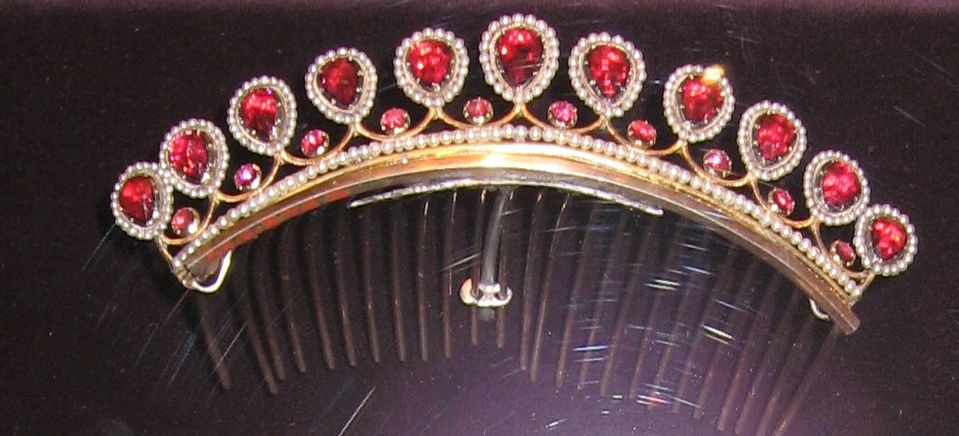
Just a few accessories that belonged to the real Betsy Bonaparte, with a portrait showing her wearing the tiara. She was 37 or 38 and living in Europe when the painting was made.

accessories

Everytime I see the photograph of this jewelry and small handbag, I think how fashionable they would have been in the 1960s!

tiara

This tiara features seed pearls and garnets.

heroine

Painting in the collection of the Maryland Historical Society, photograph by Michael Chatlien, 2011

4 Comments

Filed under Extra Tidbits

Writing Historical Fiction: Period-Appropriate Language

Today, I simply want to share a tool that I found very helpful while I was writing my novel—a website called the Online Etymology Dictionary. It’s a great resource for writing historical fiction. Every time I wondered if a certain word was appropriate for my 19th century characters to use, all I had to do was look it up on that website, and I’d learn when the word came into use and how its meaning evolved over time.

The site contains some fascinating information. For example, I knew from Betsy’s letters that she used the exclamation Fudge! What I didn’t know until I looked it up was that the expression didn’t originally come from the candy. It came from a man’s name—Captain Fudge, who was known for telling lies. That reputation gave rise to sailors using the term fudge whenever they thought they were being told lies or nonsense.

6 Comments

Filed under Writing Historical Fiction