Tag Archives: Betsy Bonaparte

Betsy’s Circle: The Man Who Saved Baltimore Twice

General Samuel Smith Rembrandt Peale
General Samuel Smith by Rembrandt Peale [Public domain], via Wikimedia Commons

The person in charge of the defense of Baltimore when the British attacked in 1814 was Samuel Smith, former revolutionary officer and current U.S. senator. He also happened to be Betsy Bonaparte’s uncle, as he was married to her mother’s older sister.

Samuel Smith was born in Pennsylvania, but his family moved to Baltimore when he was a boy, and he made Baltimore his home for the rest of his life. Like Betsy’s father, he made his money from shipping and trade. Smith served in the army during the Revolutionary War, advancing from captain to major to lieutenant colonel. He spent the winter at Valley Forge with George Washington, and he later took part in the Battles of Saratoga, which were the turning point of the war.

In his forties, Smith entered politics. He served in the House of Representatives from 1793 to 1803 and in the Senate from 1803 to 1815. His highest rank was president pro tempore of the Senate, making him third in line to the presidency.

During the War of 1812, a Baltimore officer named General William Winder had been in charge of the disastrous defense of Washington, D.C., which led to a rout of the American forces and the burning of the capital. When it came to defending their own city, Baltimoreans turned to 62-year-old Samuel Smith rather than the much-younger Winder. Smith organized the digging of fortifications to prevent a land approach and prepared to sink ships in the Patapsco River to prevent a water approach.

After the Battle of Baltimore was over, Smith returned to Congress, serving in both the Senate and the House for nearly two more decades. All together he spent 40 years in Congress.

In August 1835, Smith was once again called upon to save his city. Seventeen months earlier, the Bank of Maryland had failed, and the public had grown tired of waiting for the long-promised settlement. For several nights running, angry people gathered to attack the homes of bank directors. Samuel Smith, now eighty-three years old, organized a force of volunteers and managed to quiet the mob and convince them to disperse. The grateful city made Smith mayor, a position he held for three years. He died in 1839 at the age of 86.

Leave a comment

Filed under Extra Tidbits

Writing Historical Fiction: Channeling Your Character

fort mchenry

One hundred ninety-nine years ago today, a fleet of British ships spent a full day lobbing mortars and Congreve rockets at Fort McHenry (shown above) in an effort to capture Baltimore during the War of 1812. The British viewed the city as a “nest of pirates” because it was home to many of the privateers that had been preying on British shipping.

When I first started writing my novel The Ambitious Madame Bonaparte, I wasn’t sure whether I was going to portray the Battle of Baltimore. By then, I had read five different biographies of Betsy Bonaparte. None of them answered the question of whether she was in her hometown of Baltimore or in Washington, D.C., when the attack took place.

Then in November 2011, my husband and I traveled to Baltimore, so I could do some research. One place we visited was Fort McHenry. We were lucky enough to be able to hear one of the National Park rangers tell the story of the battle. At one point, he described how many of the residents of Baltimore climbed to their roofs so they could watch the attack and see how it was going. As he spoke, a strange thing happened.

An unexpected wave of fear washed over me, and suddenly I was no longer sitting in the bright November sunshine, listening to a ranger spin a lively tale. I was Betsy, standing on the roof of her childhood home, gripped by the dread of what would happen if the British captured the city. During the early years of her marriage, Betsy and her husband Jerome had often been threatened by British warships who wanted to make a hostage of Napoleon’s brother. Now, she feared for her beloved nine-year-old son. He was a Bonaparte, the nephew of the man the British had been fighting for more than 15 years. As I imagined Betsy’s terror, I began to cry right there in the crowd of tourists. The emotion was so powerful, so icy cold and unsettling, that I couldn’t help myself. After that, I knew with absolute certainty that I had to include the battle in the novel and that I had to portray Betsy’s desperate if somewhat irrational fears that if the British conquered Baltimore, her son would be in danger. It was exactly what I needed to make sense of what had up till then been an impersonal event.

4 Comments

Filed under Writing Historical Fiction

Betsy’s Circle: Scandalous Pauline Bonaparte

Pauline Bonaparte 2
Portrait of Pauline Bonaparte by Robert Lefevre, Image from Wikimedia Commons

Betsy was often told that she looked like her sister-in-law Pauline Bonaparte, shown above in one of her revealing gowns. Pauline, however, had a much more scandalous reputation than Betsy.

As a young woman, Pauline fell in love with Louis-Marie Stanislas Fréron, the proconsul of Marseille, but her mother objected to the match. Napoleon then married off his fifteen-year-old sister to one of his officers, General Charles Leclerc. However, Pauline couldn’t be happy with any man for long. She had a voracious sexual appetite (a trait that several of the Bonapartes shared). While she and LeClerc were stationed in Saint-Dominque, she took several lovers—despite the fact that she was plagued with illness. Pauline had an exasperating personality: arrogant, willful, capricious, narcissistic, and promiscuous.

After LeClerc died of yellow fever, Pauline returned to France. Defying Napoleon’s opinion about the proper mourning period, she married again within a year to Prince Camilo Borghese. They lived in Italy. Pauline quickly grew bored with him and continued behaving as riotously as before. They say that one of her lovers was the violinist Paganini. Other rumors say that she suffered from sexually transmitted diseases. While in Italy, Pauline posed semi-nude for the sculptor Canova, who created a famous statue of Pauline as a reclining Venus.

Pauline had only one child, a boy named Dermide, fathered by her first husband. Dermide died when he was six, and Pauline—true to her volatile nature—kept promising to make various nephews her heir and then changing her mind and rescinding the offers. In one area of her life, however, she did remain loyal. She stood by her brother Napoleon and was the only one of his siblings to visit him in his first exile on Elba.

Cancer was the scourge of the Bonaparte family, and Pauline was no exception. She died of the disease at the age of 44.

2 Comments

Filed under Extra Tidbits

19th Century Life: Gloves and Shoes

Today we return to the subject of clothing in the 1800s. In all the movies made of Jane Austen novels, we see young women attending balls wearing flimsy, lowcut, empire-waist dresses with long, elbow-length, white gloves.

When I was growing up in the 1960s, I always assumed those gloves were made of cloth the way my mother’s formal gloves were. Well, I was wrong. The gloves that Betsy Bonaparte would have worn to a ball (and she loved to go to parties) would have been made of white kid. I can’t imagine how hot it must have been to dance while wearing leather gloves covering nearly the entire arm.

Speaking of white kid, the Maryland Historical Society has a pair of white kid shoes that belonged to Betsy Bonaparte in her eighties. Even as a woman of mature years, she wanted to be fashionable and wore pumps with heels.

That brings me to a final oddity about 19th-century fashion. Did you know that in the first half of the century, there was no such thing as right and left shoes? Both shoes in a pair were shaped exactly the same. The next time you have difficulty breaking in a pair of shoes, just thank your lucky stars that you didn’t live in Betsy’s day!

Leave a comment

Filed under 19th century life

19th Century Life: Unmentionables

Saturday, my husband and I went to an interesting exhibit at the Art Institute of Chicago called Impressionism, Fashion, and Modernity, which examined the clothing portrayed in late 19th-century paintings.

The exhibit naturally made think about how different fashion was in Betsy Bonaparte’s day, and not just because the slim empire gowns she wore as a young woman were so different from the ruched, flounced, ruffled, and bustled gowns of the 1870s. One of the biggest changes was one that doesn’t normally meet the eye—the undergarments of the two periods.

When we think of 19th century undergarments for women, most of us imagine the items I saw at the exhibit: corsets and the loose, long underpants known as drawers. But at the turn of that century, people did not wear underpants. The main undergarment for women was a linen shift, which is a simple underdress. Women wore them under their gowns and then slept in them at night.

Men wore long shirts. Ever wonder why men’s shirts have such long tails? They didn’t wear underpants, so the tails prevented stains from getting on their outer garments. A linen shirt was easier to launder than wool pants. That’s also why paintings of the period show men with coats and waistcoats (vests) hiding most of their shirt except the collar. To show one’s shirt in public was akin to walking around in one’s underwear.

According to Clothing Through American History by Ann Buermann Wass and Mihelle Webb Fandrich, by 1807 a book of instructions for tailors began to recommend that men wear drawers under their outer garments for sanitary reasons.

About time, wouldn’t you say so?

5 Comments

Filed under 19th century life

Writing Historical Fiction: Anachronistic Terms

My editor e-mailed me the other day to inquire whether I was right to have characters in 1803 refer back to the Revolutionary War. We both googled the question for a while and finally settled on using War of Independence instead.

Similarly, when my newlywed couple Betsy and Jerome travel to Washington and dine with President Jefferson, I couldn’t refer to the White House. The presidential residence wasn’t painted until after the British burned it in 1814, leaving soot-blackened stone walls. So I had to call it the President’s Mansion. Those  are the kinds of mistakes it is so easy to make . . . and which I hope I have avoided. Only time will tell, I suppose. In the meantime, I’ve had a lot of fun tracking down that sort of information.

Leave a comment

Filed under Writing Historical Fiction

Betsy’s Circle: Elbridge Gerry

During her lifetime, Betsy Bonaparte knew many famous and fascinating people. One of her more unusual friendships was with Elbridge Gerry, James Madison’s second vice president. Poor President Madison had the unhappy distinction of having both his vice presidents die during their term of office. The first was George Clinton in 1812, and the second was Elbridge Gerry.

By the time he became vice president, Gerry had put in some fifty years of public service. Originally from Marblehead, Massachusetts, he served in the Continental Congress as a representative of Massachusetts, and he signed the Declaration of Independence in 1776. He also attended the Constitutional Convention but refused to sign that document because he thought it didn’t create a strong enough central government. He once said,

“The evils we experience flow from the excess of democracy. The people do not want virtue, but are dupes of pretended patriots.”

In the decades that followed, Gerry served as U.S. Congressman and as the governor of Massachusetts. It was during his term as governor that he signed a law redistricting the state along highly partisan lines—an incident that became the basis for Gerry’s most enduring legacy. His name was incorporated into our modern term gerrymandering. The -mander part of the term was borrowed from salamander because some wit thought the boundaries of the new districts looked like the outline of a lizard. Even though Gerry’s name was pronounced with a hard G—like Gary—gerrymandering is said with a soft G.

Betsy met Vice-President Gerry while she was living in Washington, D.C. during 1813, perhaps through the Madisons, who were friends. The vice president and the socialite got along well and enjoyed debating the merits of various political systems. Betsy liked having a platonic relationship with a man who appreciated her mind, rather than one who was mesmerized by her beauty. All her life, she longed to receive more recognition of her talents. Unfortunately, the rewarding friendship did not last long. Elbridge Gerry died on November 23, 1814.

2 Comments

Filed under Extra Tidbits

Writing Historical Fiction: Contradictory Records

Two hundred ten years ago, just about this time of year, American Betsy Patterson met Jerome Bonaparte, Napoleon’s youngest brother. You would think that would be one event the historical record of Betsy’s life would be clear on, but in fact, it’s one of the murkiest. No less than three different stories about their meeting exist.

They met at the races; they met at a dinner party; they met at a ball. Which one was it? One of my first tasks as a historical novelist was to sort through these accounts and figure out which to use for my story. A biographer can say, “There are conflicting reports about their meeting, and here are the stories,” but a novelist can’t do that. A novelist has to weave a seamless tale that makes sense for the characters and the time period in which they lived.

So which story did I choose and how did I portray it? Ah, you’ll have to wait until the book is published to find out.

2 Comments

Filed under Writing Historical Fiction

Paying My Respects

Image

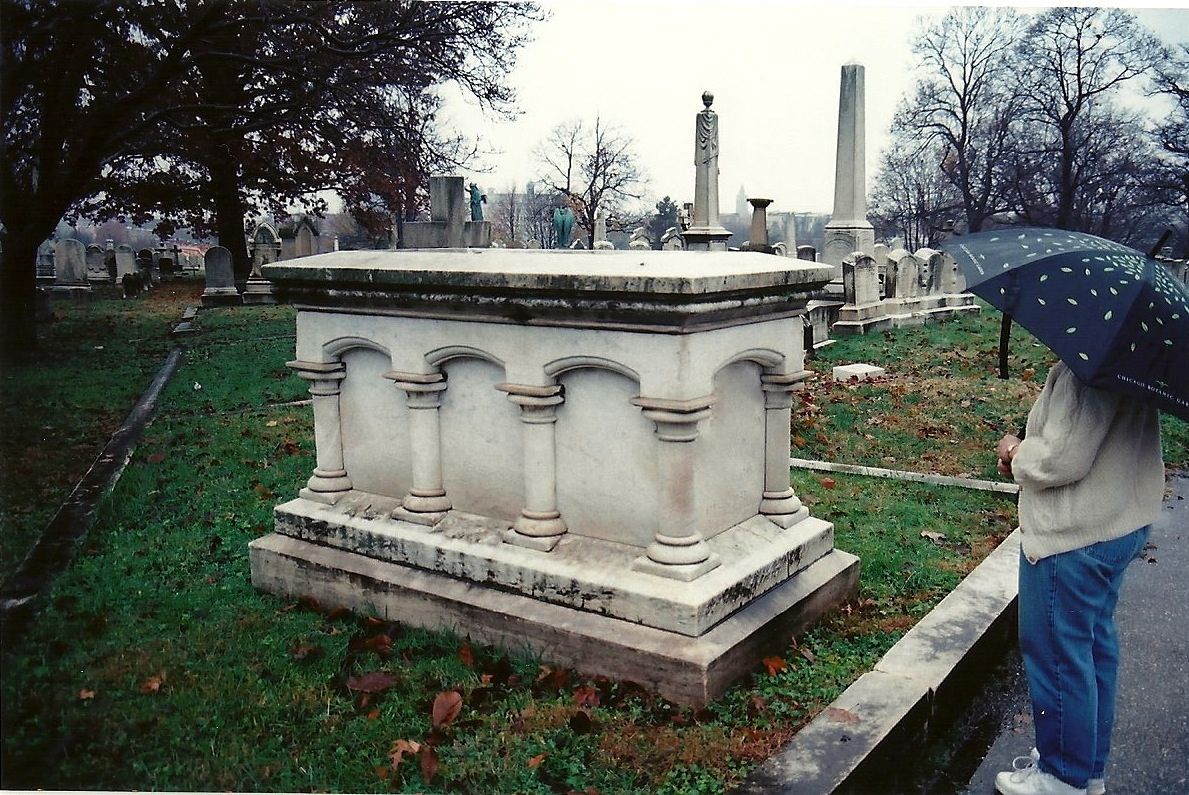
About two years ago, I started the process of writing a novel based on the life of Betsy Bonaparte. That November we traveled to her hometown of Baltimore to do research. My first full day there, I visited Betsy’s grave to pay my respects. As you can see, the grave has a high marble slab with carved columns at each corner. Misty rain was falling, and giant crows hopped from gravestone to gravestone cawing. It was like a scene out of Edgar Allan Poe. I was weeping. I promised Betsy that I would do my best to portray her fairly, without some of the stereotypes and harsh judgments that have crept into the historical records about her.

Then I found a violet blooming near her tomb. It was late autumn, yet there was a spring flower. So I picked it. I’ve never been able to smell violets. It always disappointed me bitterly as a little girl. However, the one I picked that rainy November day had a powerful scent. I took it with me to press. I still have it in a notebook I carried that week.

After leaving the cemetery, we visited a historic home that had a piece of Betsy’s furniture on display. It was a home she would have visited during her lifetime. After the tour, I found and bought a box of violet-scented powder in the gift shop. When we got back to the inn, I googled Betsy’s name and the word violet, and I discovered that the flower was associated with those who supported the Bonapartes. That was fitting. In spite of the difficulties she face, Betsy never lost her admiration for the emperor.

The whole story is eerie, n’est-ce pas? To me, it felt as thought Betsy was granting me permission to do this project. And I did my best to keep that graveyard promise to her as I wrote The Ambitious Madame Bonaparte.


9 Comments

Filed under Research