Monthly Archives: October 2013

19th Century Life: American vs. European Cities

One question that my early test readers of The Ambitious Madame Bonaparte asked me was why Betsy wanted to live in Europe so badly. What did she have against her own country?

In our current time period, when the United States is the most powerful country in the world and U.S. culture is a dominant global force, it’s hard to realize what the country was like two hundred years ago. The difference between living in an American city and living in a European capital was like the difference we’d experience between living in small-town Wisconsin and Chicago.

Look at the two graphs below, which I created using statistics I found on the Internet.

european cities 1800

U.S. cities

To further drive home the difference, here is an image of Paris in the early 1800s:

Place des Victoires by Victor-Jean Nicolle

Place des Victoires by Victor-Jean Nicolle, via Wikimedia Commons

And here is the description I wrote in the novel of Washington, D.C., in 1804:

The next day, Aunt Nancy took Betsy and Jerome on a carriage tour. After Congress had decided in 1790 to build the nation’s capital in a newly created federal district, President Washington commissioned civil engineer Pierre Charles L’Enfant to devise a plan. Originally from France, L’Enfant wanted to construct a city in the European style with important buildings set far apart to allow for public gardens and plazas. At the time of Betsy and Jerome’s visit, the wide spaces between public buildings were occupied by a mix of uncleared land, small plots with cabins, and recently built houses—giving the city of Washington the disconcerting appearance of a sparsely settled wilderness with a few grandiose structures set down at random. Stories abounded of Congressmen going squirrel hunting within the city or getting mired in a swamp as they drove to their quarters at night.

Betsy was clever, ambitious, and interested in art and literature. Is it any wonder she wanted to be in Europe where the action was?

6 Comments

Filed under 19th century life

Artifacts of a Life

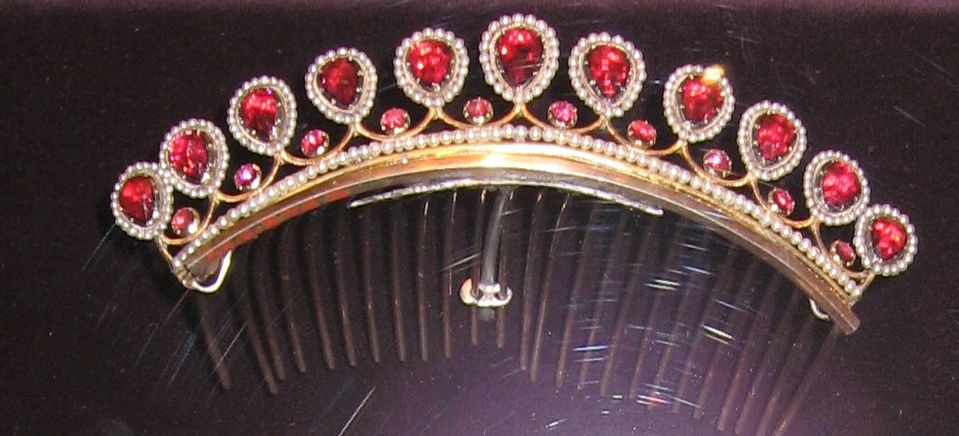
Just a few accessories that belonged to the real Betsy Bonaparte, with a portrait showing her wearing the tiara. She was 37 or 38 and living in Europe when the painting was made.

accessories

Everytime I see the photograph of this jewelry and small handbag, I think how fashionable they would have been in the 1960s!

tiara

This tiara features seed pearls and garnets.

heroine

Painting in the collection of the Maryland Historical Society, photograph by Michael Chatlien, 2011

4 Comments

Filed under Extra Tidbits

Writing Historical Fiction: Period-Appropriate Language

Today, I simply want to share a tool that I found very helpful while I was writing my novel—a website called the Online Etymology Dictionary. It’s a great resource for writing historical fiction. Every time I wondered if a certain word was appropriate for my 19th century characters to use, all I had to do was look it up on that website, and I’d learn when the word came into use and how its meaning evolved over time.

The site contains some fascinating information. For example, I knew from Betsy’s letters that she used the exclamation Fudge! What I didn’t know until I looked it up was that the expression didn’t originally come from the candy. It came from a man’s name—Captain Fudge, who was known for telling lies. That reputation gave rise to sailors using the term fudge whenever they thought they were being told lies or nonsense.

6 Comments

Filed under Writing Historical Fiction

19th Century Life: Madeira

One of the most popular wines during the early years of the United States was the wine called Madeira. Thomas Jefferson enjoyed it, and according to some reports, the wine was used to toast the Declaration of Independence. Madeira comes from the Portuguese island of the same name, which has a rich volcanic soil. The early United States had no vineyards, so all wines had to be imported, and Madeira has special qualities that allowed it to survive the long, precarious ocean crossing.

During the Age of Exploration, ships often stopped by Madeira to stock up before a long voyage, so the wine makers began to add spirits to the wine during the fermentation process to help preserve it. The other interesting feature about Madeira happened by accident. An unsold shipment of wine returned to the islands and the wine makers discovered that the heat and movement the wine had been subject to during its travels had actually changed its flavor. Manufacturers wanted to recreate this quality, so they began to heat the wine  and expose it to oxygen. The resulting wine’s ability to withstand the rigors of lengthy voyages made it perfect to ship to the American market.

There are many styles of Madeira, made from different grapes. Some are dry, and others are sweet. The most popular variety in Baltimore, Betsy’s hometown, was a variety called Rainwater. It was a pale, delicate variety usually made from Tinta Negra Mole grapes. There is an interesting story about how it got its name. According to legend, some casks were left out on the dock and became diluted when it rained. The unscrupulous dealers sold the wine anyway, and lo and behold, their American customers liked it.

Rainwater Madeira is difficult to find now as it has fallen out of fashion. I’d love to try it sometime, though, just to taste something that Betsy must have tasted.

Leave a comment

Filed under 19th century life

Writing Historical Fiction: Description with Purpose

White-HousePublic domain engraving, via Wikimedia Commons

A question that arises when writing historical fiction is how much description to use. One of the joys of reading historical fiction is to gain a glimpse into the past, and choosing the right descriptive details can make a distant time period come alive. However, a lot of contemporary readers are accustomed to a cleaner, more pared-down style of narrative than was typical in the past. Gone are the days when a writer can wax poetic about scenery for two pages and expect the reader to enjoy it.

I was so worried about going on too long that I actually made the mistake of using too little description in my original version of The Ambitious Madame Bonaparte. So I had to do a big revision over the summer because my editor wanted me to flesh out Betsy’s world a bit more.

Even so, I wanted to make sure that the descriptions I added carried their weight. Whenever I could, I used descriptions that added an extra layer of meaning to the novel. For example, this description not only describes the building where Betsy goes to school, it helps the reader understand the history of Baltimore and of Betsy’s teacher:

To Betsy’s delight, her father did enroll her in school. Madame Lacomb and her husband had been low-ranking nobles who had fled to Saint-Domingue during the French Revolution. Monsieur Lacomb died not long afterward, and Madame Lacomb came to Baltimore with other refugees from the slave revolt of 1793. She moved into a small, blue wooden house that was as much a survivor of a different era as she was—it had been built in the 1750s and remained standing as more imposing brick townhomes replaced the wooden houses around it.

Descriptions can also reveal a lot about your main character. People naturally relate the things they notice to their own desires and goals, as in the following scene:

Jerome and Betsy were invited to dinner at the President’s Mansion.  .  .  .  For the occasion, which would begin at 3:00 in the afternoon and last until late evening, Betsy wore a sheer gown bedecked with gold embroidery that would sparkle in the candlelight. This would be her first visit to the home of a head of state, and she wanted to demonstrate to Jerome that she knew how to dress for such occasions.

As the Smith carriage drove up to the north entrance, Betsy stared avidly at the details of the building and wondered how it compared to the palaces she would someday live in with Jerome. The President’s Mansion was an imposing light-grey stone structure, wide enough that eleven windows stretched across its upper story. The center block of the mansion was decorated with four Doric columns crowned by a triangular pediment. A small pediment also topped each window, but Betsy was surprised to see that they were not all the same. Rather, triangles alternated with rounded arches.

And sometimes, descriptions can be used to convey the humorous or unexpected:

When she and Jerome were presented to President Jefferson, Betsy was amused to see him in the characteristically plain dress he wore on republican principle: an old blue coat, dark corduroy breeches, dingy white hose, and run-down backless slippers.

Those were a few of the techniques I used to add extra layers of meaning to description.

1 Comment

Filed under Writing Historical Fiction

Betsy’s Circle: Victor Marie du Pont

Among the French emigrés that Betsy and Jerome knew in the United States were Victor and Gabrielle du Pont, of the famed Du Pont family.

Victor Marie du Pont was born in Paris on October 1, 1767 — 246 years ago today. At the age of 17, he began to work with his father in the Bureau of Commerce. France was still a monarchy at the time. In 1788, the year before the French Revolution, du Pont went to the United States to work with the French minister here. Over the next few years, du Pont traveled back and forth between the two countries, but in 1800, the entire Du Pont family moved to the United States for good.

Victor du Pont established a trading company in New York and helped provide supplies to the French troops in Santo Domingo. Victor’s company went bankrupt, partially because the French government didn’t pay him. (There are also reports that du Pont went deeply into debt entertaining Betsy and her husband. Jerome was the emperor’s baby brother after all.) Victor’s brother, Eleuthère Irénée du Pont, was more successful. He founded the chemical company that still bears the family name.

In 1811, Victor and his family moved to Delaware, where he founded a wool manufacturing company. He eventually served in the Delaware State House and State Senate. One of his sons was a rear admiral during the Civil War.

Leave a comment

Filed under Extra Tidbits