Tag Archives: 19th century

19th Century Life: Madeira

One of the most popular wines during the early years of the United States was the wine called Madeira. Thomas Jefferson enjoyed it, and according to some reports, the wine was used to toast the Declaration of Independence. Madeira comes from the Portuguese island of the same name, which has a rich volcanic soil. The early United States had no vineyards, so all wines had to be imported, and Madeira has special qualities that allowed it to survive the long, precarious ocean crossing.

During the Age of Exploration, ships often stopped by Madeira to stock up before a long voyage, so the wine makers began to add spirits to the wine during the fermentation process to help preserve it. The other interesting feature about Madeira happened by accident. An unsold shipment of wine returned to the islands and the wine makers discovered that the heat and movement the wine had been subject to during its travels had actually changed its flavor. Manufacturers wanted to recreate this quality, so they began to heat the wine  and expose it to oxygen. The resulting wine’s ability to withstand the rigors of lengthy voyages made it perfect to ship to the American market.

There are many styles of Madeira, made from different grapes. Some are dry, and others are sweet. The most popular variety in Baltimore, Betsy’s hometown, was a variety called Rainwater. It was a pale, delicate variety usually made from Tinta Negra Mole grapes. There is an interesting story about how it got its name. According to legend, some casks were left out on the dock and became diluted when it rained. The unscrupulous dealers sold the wine anyway, and lo and behold, their American customers liked it.

Rainwater Madeira is difficult to find now as it has fallen out of fashion. I’d love to try it sometime, though, just to taste something that Betsy must have tasted.

Leave a comment

Filed under 19th century life

Writing Historical Fiction: Researching Period Furniture

The following photographs are pictures I took of period furniture displayed in the Maryland Historical Society. During the writing of the novel, I had to do a lot more research than this, but it gave me start.

bed and bed steps

Notice that the bed steps open up to reveal a potty seat — for when nature calls in the middle of the night. (I seem to be pursuing a theme this week!)

sidechair

Bejamin Latrobe designed this chair for Dolley Madison to use in the drawing room of the President’s Mansion. (It wasn’t called the White House until after the War of 1812.)

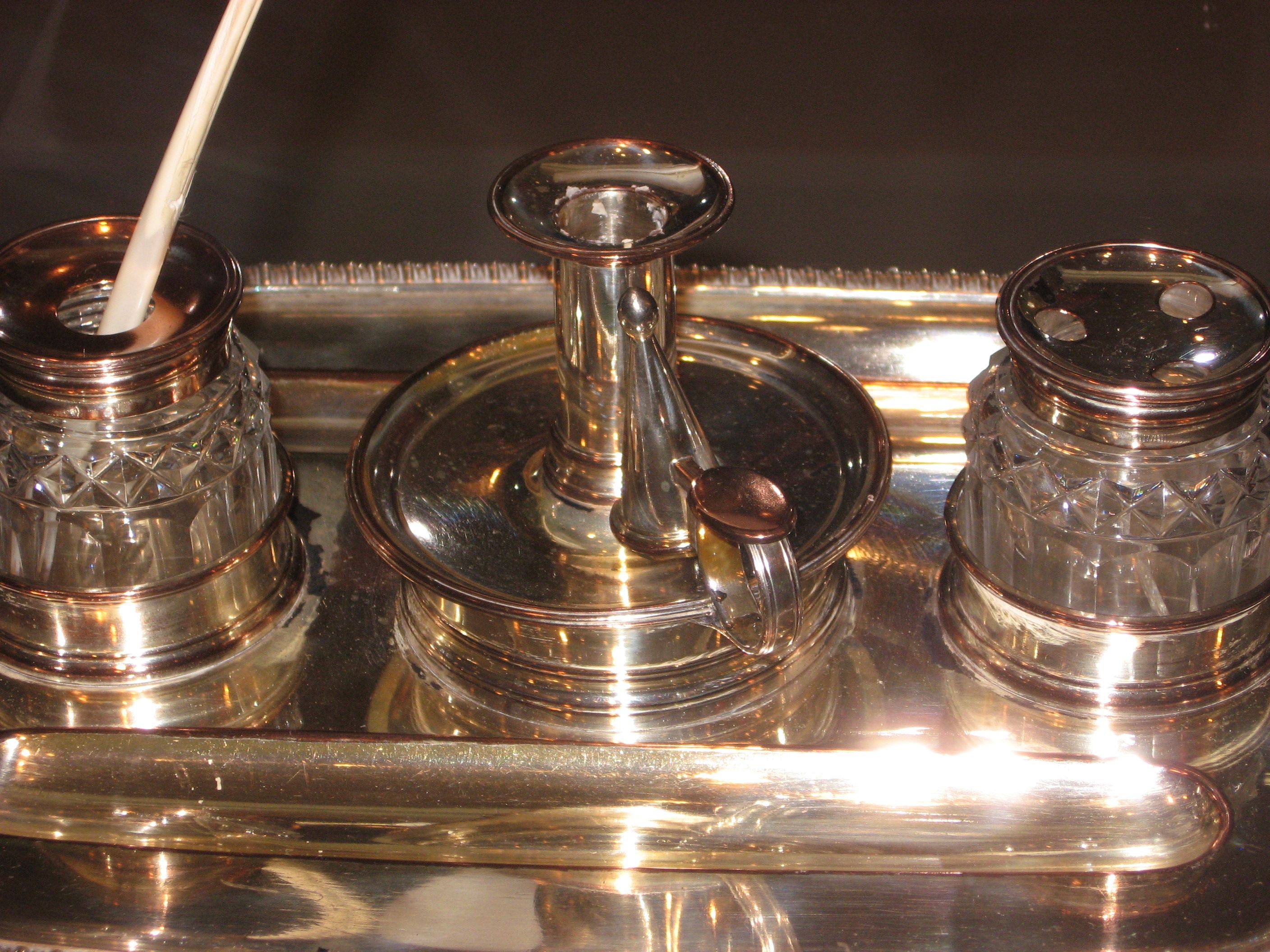
inkstand

Charles Pinkney, U.S. Attorney General, used this inkstand to write a draft of the declaration of war against Great Britain in 1812.

dresser

I didn’t use anything like this particular piece of furniture in the novel, but I love the exuberance of this dressing table. The figures on the upper doors represented Commerce and Industry.

armchair

This armchair inspired me to choose teal upholstery for the furniture Betsy’s parents had in their drawing room.

couch

I love the color combination on the Grecian couch. It helped me to realize that the color palette from Betsy’s time period wasn’t quite as somber as I might have assumed.

8 Comments

Filed under Uncategorized

Writing Historical Fiction: 19th c. Information Lag

While I was planning the plot of The Ambitious Madame Bonaparte, I had to deal with what I call information lag. In the current age of instant communication, it’s hard to remember how long it once took for news to travel.

In the early 1800s, it took a day to travel the 45 miles from Baltimore to Washington. It could take four days to go from Baltimore to New York. Not only were the travel times long, but mail was not secure. Travelers sometimes amused themselves by opening and reading packets of letters that were in transit.

The times for transatlantic travel were obviously much worse. An exceptionally fast ship could make the crossing in three weeks, but six weeks to two months was more typical. As a result, information lag had a huge impact on the love story in my novel.

Think about it. You’re a lusty young man, impulsive by nature, who is accustomed to using your position as Napoleon’s brother to get what you want. On a brief visit to the United States, you meet the most beautiful, witty girl you’ve ever encountered. You know your brother would expect you to ask him before you decide to marry, but frankly, you’re tired of being treated like a child—and it’s obvious that you have many rivals for the young woman’s hand. Would you want to wait four months for a ship to cross the Atlantic and back again to find out what your family thinks of your choice? Especially knowing that the letter might be lost and you’ll have to start all over again six months from now?

No, I didn’t think so.

Although I’m sure it was exasperating to Betsy and Jerome, as a writer, I was grateful for the information lag because it helped to add considerable tension to the plot. The specifics of how that tension plays out will not be revealed until the book is published. (That’s my contemporary version of information lag.)

vigilante

8 Comments

Filed under Writing Historical Fiction

This Date in History: September 10, 1813

The War of 1812, largely forgotten today, plays a significant role in my novel The Ambitious Madame Bonsparte, and today is the anniversary of a significant event in the war. Two hundred years ago on this date, the United States Navy won one of the first great victories of its existence. Let me provide a little background.

In June 1812, the United States declared war against Great Britain for several reasons:

• First, the British navy had been stopping American ships and impressing any sailors it found who had been born in Britain—even if they had since become U.S. citizens. This was a violation of U.S. rights as an independent nation.

• Second, Britain was at war with France, and to weaken its enemy, the British navy was trying to stop the United States from trading with France.

• Third, there had been conflicts between the United States and Native Americans of the Northwest Territory, and many Americans suspected that Britain was egging the natives on.

• Fourth, some Americans had their eye on conquering Canada and adding it to our territory.

Even though the United States was the one to declare war, it was a young nation that was woefully unprepared for conflict. The army had fewer than 12,000 men, and the navy had roughly 20 ships. In July 1812, when an American force under General William Hull (no relation as far as I know) invaded Ontario, they were driven out of Canada and forced to surrender, thus losing Detroit.

The U.S. navy went on a ship-building spree to try to gain control of the Great Lakes. On September 12, 2013, Oliver Hazard Perry led a fleet of nine small ships into Lake Erie. Perry’s flagship was the Lawrence, which he had named after his friend James Lawrence, a naval officer who was killed in battle earlier in the war. (Lawrence’s gift to history was the saying, “Don’t give up the ship,” which he commanded his crew as he lay dying.) The other large ship of the U.S. fleet was the Niagara.

The U.S. fleet began the battle by attacking the two largest vessels of the six ships in the British fleet. The Lawrence was badly damaged, and Perry rowed to the Niagara to continue the attack. The Niagara sailed right at the British ships, raking them with broadsides. Within 15 minutes, the British fleet surrendered. Perry sent a famous message to William Henry Harrison, the army commander:

“We have met the enemy, and they are ours.”

The Battle of Lake Erie allowed the United States to retake Detroit, control Lake Erie, and even conquer part of Canada.

For his part, Oliver Hazard Perry became a national hero. He was promoted and given a gold medal. Six years later, he caught yellow fever while on a mission to South America and died at the age of 34.

1 Comment

Filed under This Date in History

19th Century Life: Unmentionables

Saturday, my husband and I went to an interesting exhibit at the Art Institute of Chicago called Impressionism, Fashion, and Modernity, which examined the clothing portrayed in late 19th-century paintings.

The exhibit naturally made think about how different fashion was in Betsy Bonaparte’s day, and not just because the slim empire gowns she wore as a young woman were so different from the ruched, flounced, ruffled, and bustled gowns of the 1870s. One of the biggest changes was one that doesn’t normally meet the eye—the undergarments of the two periods.

When we think of 19th century undergarments for women, most of us imagine the items I saw at the exhibit: corsets and the loose, long underpants known as drawers. But at the turn of that century, people did not wear underpants. The main undergarment for women was a linen shift, which is a simple underdress. Women wore them under their gowns and then slept in them at night.

Men wore long shirts. Ever wonder why men’s shirts have such long tails? They didn’t wear underpants, so the tails prevented stains from getting on their outer garments. A linen shirt was easier to launder than wool pants. That’s also why paintings of the period show men with coats and waistcoats (vests) hiding most of their shirt except the collar. To show one’s shirt in public was akin to walking around in one’s underwear.

According to Clothing Through American History by Ann Buermann Wass and Mihelle Webb Fandrich, by 1807 a book of instructions for tailors began to recommend that men wear drawers under their outer garments for sanitary reasons.

About time, wouldn’t you say so?

5 Comments

Filed under 19th century life