Category Archives: Writing Historical Fiction

Writing Historical Fiction: Period-Appropriate Language

Today, I simply want to share a tool that I found very helpful while I was writing my novel—a website called the Online Etymology Dictionary. It’s a great resource for writing historical fiction. Every time I wondered if a certain word was appropriate for my 19th century characters to use, all I had to do was look it up on that website, and I’d learn when the word came into use and how its meaning evolved over time.

The site contains some fascinating information. For example, I knew from Betsy’s letters that she used the exclamation Fudge! What I didn’t know until I looked it up was that the expression didn’t originally come from the candy. It came from a man’s name—Captain Fudge, who was known for telling lies. That reputation gave rise to sailors using the term fudge whenever they thought they were being told lies or nonsense.

6 Comments

Filed under Writing Historical Fiction

Writing Historical Fiction: Description with Purpose

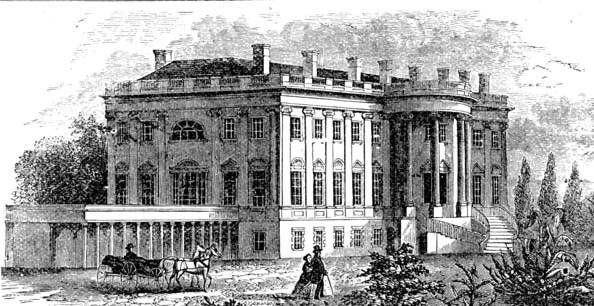
White-HousePublic domain engraving, via Wikimedia Commons

A question that arises when writing historical fiction is how much description to use. One of the joys of reading historical fiction is to gain a glimpse into the past, and choosing the right descriptive details can make a distant time period come alive. However, a lot of contemporary readers are accustomed to a cleaner, more pared-down style of narrative than was typical in the past. Gone are the days when a writer can wax poetic about scenery for two pages and expect the reader to enjoy it.

I was so worried about going on too long that I actually made the mistake of using too little description in my original version of The Ambitious Madame Bonaparte. So I had to do a big revision over the summer because my editor wanted me to flesh out Betsy’s world a bit more.

Even so, I wanted to make sure that the descriptions I added carried their weight. Whenever I could, I used descriptions that added an extra layer of meaning to the novel. For example, this description not only describes the building where Betsy goes to school, it helps the reader understand the history of Baltimore and of Betsy’s teacher:

To Betsy’s delight, her father did enroll her in school. Madame Lacomb and her husband had been low-ranking nobles who had fled to Saint-Domingue during the French Revolution. Monsieur Lacomb died not long afterward, and Madame Lacomb came to Baltimore with other refugees from the slave revolt of 1793. She moved into a small, blue wooden house that was as much a survivor of a different era as she was—it had been built in the 1750s and remained standing as more imposing brick townhomes replaced the wooden houses around it.

Descriptions can also reveal a lot about your main character. People naturally relate the things they notice to their own desires and goals, as in the following scene:

Jerome and Betsy were invited to dinner at the President’s Mansion.  .  .  .  For the occasion, which would begin at 3:00 in the afternoon and last until late evening, Betsy wore a sheer gown bedecked with gold embroidery that would sparkle in the candlelight. This would be her first visit to the home of a head of state, and she wanted to demonstrate to Jerome that she knew how to dress for such occasions.

As the Smith carriage drove up to the north entrance, Betsy stared avidly at the details of the building and wondered how it compared to the palaces she would someday live in with Jerome. The President’s Mansion was an imposing light-grey stone structure, wide enough that eleven windows stretched across its upper story. The center block of the mansion was decorated with four Doric columns crowned by a triangular pediment. A small pediment also topped each window, but Betsy was surprised to see that they were not all the same. Rather, triangles alternated with rounded arches.

And sometimes, descriptions can be used to convey the humorous or unexpected:

When she and Jerome were presented to President Jefferson, Betsy was amused to see him in the characteristically plain dress he wore on republican principle: an old blue coat, dark corduroy breeches, dingy white hose, and run-down backless slippers.

Those were a few of the techniques I used to add extra layers of meaning to description.

1 Comment

Filed under Writing Historical Fiction

Characters Who Speak a Foreign Language, Part Two

My post on foreign language dialogue Tuesday sparked a conversation in the comments with another writer about the subject—a conversation that reminded me of another technique I used in The Ambitious Madame Bonaparte. This technique doesn’t indicate that someone is speaking in another language; rather, it shows that a speaker has an accent. Rather than alter the spelling of English words to indicate that, I played with word order based on what I knew of the character’s first language. Here’s an example of what I mean:

I have a scene where a ship is being refused admittance to the port at Amsterdam:

As the boat turned back, the old Dutch pilot slapped his forehead. “Verdomme! Idioot!” He snatched the salt-stained cap from his head and wrung it between his hands.

“What is wrong?” Captain Stephenson demanded.

“Three weeks ago, a notice I read describing this ship and forbidding us from guiding her. Now, Jezus Christus, I will be hanged unless my age and bad memory they excuse.”

Just a hint of this can go a long way toward making a speaker sound foreign, and it’s much less phony than writing something like “Tree weeks ago, a notice I ret tescribing dis ship,” etc.

5 Comments

Filed under Writing Historical Fiction

Writing Historical Fiction: 19th c. Information Lag

While I was planning the plot of The Ambitious Madame Bonaparte, I had to deal with what I call information lag. In the current age of instant communication, it’s hard to remember how long it once took for news to travel.

In the early 1800s, it took a day to travel the 45 miles from Baltimore to Washington. It could take four days to go from Baltimore to New York. Not only were the travel times long, but mail was not secure. Travelers sometimes amused themselves by opening and reading packets of letters that were in transit.

The times for transatlantic travel were obviously much worse. An exceptionally fast ship could make the crossing in three weeks, but six weeks to two months was more typical. As a result, information lag had a huge impact on the love story in my novel.

Think about it. You’re a lusty young man, impulsive by nature, who is accustomed to using your position as Napoleon’s brother to get what you want. On a brief visit to the United States, you meet the most beautiful, witty girl you’ve ever encountered. You know your brother would expect you to ask him before you decide to marry, but frankly, you’re tired of being treated like a child—and it’s obvious that you have many rivals for the young woman’s hand. Would you want to wait four months for a ship to cross the Atlantic and back again to find out what your family thinks of your choice? Especially knowing that the letter might be lost and you’ll have to start all over again six months from now?

No, I didn’t think so.

Although I’m sure it was exasperating to Betsy and Jerome, as a writer, I was grateful for the information lag because it helped to add considerable tension to the plot. The specifics of how that tension plays out will not be revealed until the book is published. (That’s my contemporary version of information lag.)

vigilante

8 Comments

Filed under Writing Historical Fiction

Writing Historical Fiction: Foreign-Language Dialogue

Although the first part of The Ambitious Madame Bonaparte is set in the United States, one of my main characters is European. Jerome Bonaparte’s first language was Italian, and his second was French. Betsy had studied French from an emigré when she was a schoolgirl, and her lifelong dream was to live in France, so it only made sense to assume that the two of them spoke French to each other quite often.

The problem is that many of my readers won’t know that language. So how does a writer tackle this issue? I took a variety of approaches.

One tactic is to write the dialogue in English but to say that it was said in French, as in the following example:

The two young men were speaking in French and, apparently assuming that Americans could not understand the language, spoke at full volume even though their comments were far from discreet. Betsy, who had learned French from Madame Lacomb, heard one of them say, “Bonaparte, I think the young lady before us is the one whom Mlle. Pascault described, the girl called the Belle of Baltimore. Certainly, I have not seen anyone else who fits the description.”

A second tactic is to sprinkle the text with small phrases that are either well known or similar enough to English that they are easy to figure out:

Pardonnez moi.” Jerome bowed, sweeping his arm elegantly to one side.

A third tactic—and this one is my favorite—is to plant context clues in the surrounding text, so the reader won’t feel lost even if they don’t understand exactly what the characters are saying:

Jerome lowered his voice. “Je rêve du jour quand je te présenterai à Napoléon. Il verra que j’ai choisi un femme aussi élégante que Josephine.

Although Betsy felt gratified that Jerome would compare her favorably to Josephine, she could not allow him to assume their marriage was a certain thing.

Because a large part of Betsy and Jerome’s story concerned the interaction between and comparisons of two different cultures, I wanted their dialogue to show that. These three techniques allowed me to accomplish that goal.

12 Comments

Filed under Writing Historical Fiction

Writing Historical Fiction: Back Story

Jérôme Bonaparte - Sophie Lienard
Jerome Bonaparte by Sophie Lienard, on Wikimedia Commons

What brought Napoleon Bonaparte’s brother Jerome to Baltimore of all places? Well, for one thing, Baltimore was the third largest U.S. city in the early 1800s, behind New York and Philadelphia. It was one of the country’s most important ports.

Second, a year or so earlier, Napoleon had decided that his baby brother was going to become the naval expert of the family. Accordingly, Jerome was made a lieutenant (even though he was technically too young) and sent to the West Indies. While there, he made a colossal error of judgment that might have had serious international repercussions, so his commanding officer ordered him to return home to report to his brother, who at the time was First Consul of the French Republic.

Britain and France were technically at peace during 1803, but relations between the two countries remained uneasy. French officials were understandably nervous about exposing a member of Napoleon’s family to possible danger should war break out again while he was en route. They decided Jerome should go to a U.S. port and sail on a neutral ship—and thus, hopefully, escape the notice of the British navy.

So Jerome went to Baltimore, where his friend Joshua Barney lived. Being a young man who loved amusement and pretty girls, Jerome decided to enjoy himself while he was there. He soon began to hear about a beautiful young woman named Betsy Patterson, known as the Belle of Baltimore, and grew eager to meet her. From all accounts, Jerome had a way with young women, but he never took any of his amours seriously. I’m guessing he thought he could have a fling and then be on his way with little consequence to himself. However, Betsy proved to be more than a match for the charming young Corsican. When they met, he was instantly smitten. As the saying goes, the thunderbolt struck, and any interest Jerome had in returning home disappeared.

2 Comments

Filed under Writing Historical Fiction

Writing Historical Fiction: Channeling Your Character

fort mchenry

One hundred ninety-nine years ago today, a fleet of British ships spent a full day lobbing mortars and Congreve rockets at Fort McHenry (shown above) in an effort to capture Baltimore during the War of 1812. The British viewed the city as a “nest of pirates” because it was home to many of the privateers that had been preying on British shipping.

When I first started writing my novel The Ambitious Madame Bonaparte, I wasn’t sure whether I was going to portray the Battle of Baltimore. By then, I had read five different biographies of Betsy Bonaparte. None of them answered the question of whether she was in her hometown of Baltimore or in Washington, D.C., when the attack took place.

Then in November 2011, my husband and I traveled to Baltimore, so I could do some research. One place we visited was Fort McHenry. We were lucky enough to be able to hear one of the National Park rangers tell the story of the battle. At one point, he described how many of the residents of Baltimore climbed to their roofs so they could watch the attack and see how it was going. As he spoke, a strange thing happened.

An unexpected wave of fear washed over me, and suddenly I was no longer sitting in the bright November sunshine, listening to a ranger spin a lively tale. I was Betsy, standing on the roof of her childhood home, gripped by the dread of what would happen if the British captured the city. During the early years of her marriage, Betsy and her husband Jerome had often been threatened by British warships who wanted to make a hostage of Napoleon’s brother. Now, she feared for her beloved nine-year-old son. He was a Bonaparte, the nephew of the man the British had been fighting for more than 15 years. As I imagined Betsy’s terror, I began to cry right there in the crowd of tourists. The emotion was so powerful, so icy cold and unsettling, that I couldn’t help myself. After that, I knew with absolute certainty that I had to include the battle in the novel and that I had to portray Betsy’s desperate if somewhat irrational fears that if the British conquered Baltimore, her son would be in danger. It was exactly what I needed to make sense of what had up till then been an impersonal event.

4 Comments

Filed under Writing Historical Fiction

Writing Historical Fiction: Anachronistic Terms

My editor e-mailed me the other day to inquire whether I was right to have characters in 1803 refer back to the Revolutionary War. We both googled the question for a while and finally settled on using War of Independence instead.

Similarly, when my newlywed couple Betsy and Jerome travel to Washington and dine with President Jefferson, I couldn’t refer to the White House. The presidential residence wasn’t painted until after the British burned it in 1814, leaving soot-blackened stone walls. So I had to call it the President’s Mansion. Those  are the kinds of mistakes it is so easy to make . . . and which I hope I have avoided. Only time will tell, I suppose. In the meantime, I’ve had a lot of fun tracking down that sort of information.

Leave a comment

Filed under Writing Historical Fiction

Writing Historical Fiction: Contradictory Records

Two hundred ten years ago, just about this time of year, American Betsy Patterson met Jerome Bonaparte, Napoleon’s youngest brother. You would think that would be one event the historical record of Betsy’s life would be clear on, but in fact, it’s one of the murkiest. No less than three different stories about their meeting exist.

They met at the races; they met at a dinner party; they met at a ball. Which one was it? One of my first tasks as a historical novelist was to sort through these accounts and figure out which to use for my story. A biographer can say, “There are conflicting reports about their meeting, and here are the stories,” but a novelist can’t do that. A novelist has to weave a seamless tale that makes sense for the characters and the time period in which they lived.

So which story did I choose and how did I portray it? Ah, you’ll have to wait until the book is published to find out.

2 Comments

Filed under Writing Historical Fiction