Tag Archives: book review

Book Review: America’s Fool

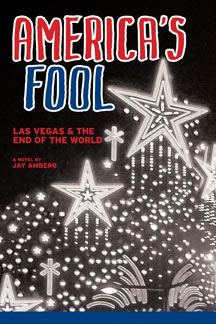
cover_af

I recently read America’s Fool: Las Vegas & the End of the World by Jay Amberg, which was a fun read. The book is a thriller set during the Obama administration, probably in the first year or two after the Great Recession.

Andy Wright is a TV reporter who is more of a pretty-boy personality than a hard-core journalist. While in Las Vegas to film a series of stories about how the recession hit the city, he goes hiking in Red Rock Canyon. When a hailstorm kicks up, he takes refuge in a cave and falls down a rock chimney, landing in a chamber with a hidden cache of mysterious canisters. As he inspects them, something stings him from behind, and he passes out. The next thing he knows, Wright wakes up by the side of a road on the other side of the ridge where he had taken refuge—to discover that a beautiful, female Iranian doctor has found him and is attending to his bruises. If that’s not strange enough, when Wright gets to his feet, he notices there are no tracks—none at all—to hint at how he got to where he is.

The series of mysteries nags at Wright, who has grown more than a little disillusioned about how glib his career has become. He and his producer, Maggie McNamara, start looking for answers, and at first, discover more questions. Who is Dr. Fereshteh Raisani, and how did she happen to come along a little-used road just when Wright needed her? And who is Nick Larson, the solitary desert wanderer that Wright meets when he goes back to find the motorcycle that got left in the desert when he had his accident?

Little by little, Wright and his producer uncover a terrifying plot. Joseph Wengelt, the fanatical leader of a religious cult that lives on a compound in the Mojave Desert, has decided to summon forth the “Day of the Lord” upon sinful, apostate America by unleashing the most virulent poison ever invented. He is aided in his plan by an ignorant white supremacist and a cold-blooded security officer who dreams of establishing his version of constitutional government. Wright and McNamara remain hampered by what they don’t know. When is the attack supposed to take place? What are the targets of the conspiracy? Do they know for certain where all the canisters of poison are—and if not, will their investigation trigger a pre-emptive strike?

America’s Fool has well-drawn characters and vividly described settings. It was a fast-paced read that kept me enthralled during a long afternoon of sitting in a hospital waiting for tests—despite the noise of the ubiquitous television and the chatter of patients and medical personnel at the nearby reception desk. I think that’s a pretty strong recommendation.

4 Comments

Filed under Book Reviews

Book Review: Unravelled

unravelled

I just finished reading the historical novel Unravelled by M.K. Tod. It has an interesting premise summed up by its log line: “Two wars. Two affairs. One marriage.”

The novel opens in 1935. Canadian veteran Edward Jamieson has received an invitation to go to France to commemorate the Battle of Vimy Ridge. Edward has struggled to overcome what we now call PTSD and later hidden his memories of the war from his wife Ann. So, he’s not eager to return to the place where he survived such horror. Yet, something else from his past—the memory of a passionate love he lost during the chaos of wartime—compels him to make the journey. What he finds in France leads to a marital crisis nearly as destructive as a battle.

Flash forward a few years to the eve of World War II. Although his age and permanent lung damage from the first war prevent Edward from signing up for active duty, he finds another way to serve his country—a way that must be kept secret from his family. Ann, in turn, finds herself struggling against loneliness, resentment, . . . and unexpected temptation. Is the Jamieson marriage strong enough to survive so many external stressors? That is the central question at the heart of this book.

The writing makes it evident that Tod did her research meticulously, yet she is judicious in her choice of details. Not once in the course of the book did I feel that she was piling on interesting facts just to show off her hard-earned knowledge. Tod also is unsparing in portraying the effect of war on families, but she avoids melodrama or maudlin sentimentality.

My biggest regret about the story is that I wanted to see what Ann and Edward were like together in happier times, before the decade of turmoil portrayed in this novel. In some of the conversations where they discuss their problems, they refer to what their relationship has lost. And they think things like, “I miss Ann’s sense of humor.” As a writer, I imagine that, in dealing with such an epic story, Tod had to make difficult choices about what to include in the plot. However, as a reader, I would have liked to have briefly glimpsed that more ideal time through a dramatic scene or two instead of having the characters tell me what they lost. Such scenes would have given me a sharper sense of the damage and raised my emotional stakes in the survival of the marriage.

I don’t mean to imply that I didn’t care about the characters. I did, and I felt compelled to continue with their story because I wanted to know what happened. Despite an exceptionally busy work schedule, I read the book in less than a week. It was also interesting to read a novel from the Canadian point of view. Most of the other novels I’ve read set during the two world wars have been told from a U.S., European, or Asian perspective.

Lovers of historical fiction, especially those interested in the two world wars, will find this a captivating story. The novel will also appeal to readers who like to explore the inner workings of a marriage. For these reasons, I recommend Unravelled without hesitation.

5 Comments

Filed under Book Reviews

Book Review: The Sandcastle Girls

The Sandcastle Girls by Chris Bohjalian tells the story of the Armenian genocide through the vehicle of one family’s history. Bohjalian is himself the grandson of Armenian survivors, so this story was a way for him to explore a topic of personal significance. However, the book is a work of fiction rather than thinly disguised family history.

The novel is narrated by contemporary Armenian-American novelist Laura Petrosian, who starts to dig into her grandparents’ past after discovering a photograph of a female genocide survivor who had the same last name as hers but who was not, as far as she knows, a relative. Laura learns that a museum has an archive of her grandmother’s papers, and through them, she uncovers a long-buried past with elements of horror, brutality, tragedy, and love.

Switch to 1915. A group of well-intentioned Americans from the group Friends of Armenia travel to Aleppo, Syria, to take food and medical help to Armenian refugees whom the Turks have forced from their homes. Among the American group are Silas Endicott, a wealthy Bostonian, and his headstrong, compassionate daughter Elizabeth. They are shocked by the cruel reality that confronts them on their arrival. Women and children have been marched hundred of miles through a searing desert. Most of them died long before reaching Syria. Those few who make it to Aleppo are subjected to further barbarities there. The book doesn’t shy away from letting the reader know how terrible a crime was inflicted upon the Armenian people, but it doesn’t wallow in gory details just for the sake of sensationalism.

While the Americans are preparing to take humanitarian supplies to a refugee camp out in the desert, Elizabeth meets Armen Petrosian, a young Armenian engineer who was away from home working on  the railroad when the deportations from Armenia began. He has heard that his wife and infant daughter are among the dead, but he has been unable to learn the exact circumstances of how they died. He and Elizabeth are drawn to each other immediately, but he cannot remain in Aleppo. He joins the British army, so he can fight the Turks that are trying to wipe out his entire culture. Yet, he and Elizabeth cannot forget their brief relationship, and they write to each other, hoping against all reason that they will see each other again.

In Armen’s absence, Elizabeth deepens her relationship with two other Armenian survivors—a widow and an orphan child who is a voluntary mute because she has seen unspeakable horrors. And as Armen experiences battle, he realizes that the internal forces driving him have changed forever.

These stories from the past are interwoven with chapters recounting Laura’s investigation. And that’s perhaps my biggest issue with the book. I think there are more present episodes than are necessary for the telling of this story. I think Chris Bohjalian, the author, spent too much time on the narrator’s search and discovery of the past because it in some way mirrored his own emotional process. But he may have lost sight of his readers. I began to get impatient with the interruptions. The compelling story is the one in the past. And it’s engrossing enough that I ultimately forgave the times I felt impatient to get back to it.

The other major criticism I had with the story was the use of a flagrantly improbable coincidence in the climax of the past history. Despite that, I still recommend the book strongly. It tells an important story and does so dramatically, not polemically or didactically, but through characters that we truly care about. That’s worth forgiving a few flaws.

Leave a comment

Filed under Book Reviews