Category Archives: Romance

Sunday Review: Last Call at Smokey Row by Pat Camalliere

Last Call at Smokey Row is a departure for Pat Camalliere, whose previous novels are part of a series of historical mysteries that take place in Lemont, IL. Although also set in Lemont, the latest novel is more what I’d classify as a contemporary woman’s novel set in the early 1980s. 

The main character and narrator, Jane Archer, is someone many people can relate to. Raised in a Catholic family, she pursued the goals she thought a good, responsible girl should: education, marriage, a suitable career for a woman—in her case, teaching high school biology. But at the age of 33, she finds herself a divorced ex-teacher, living alone for the first time in her life, working a dead-end job in a grocery store, and wondering if she has the stamina and motivation to figure out what to do next. 

Invited by a coworker who participates in a pool league, Jane visits a local tavern called Sami’s. There she meets a collection of people seemingly as adrift as she is: a divorced father being bled dry by his ex, a young woman with no apparent ambition, a traumatized Vietnam vet who rarely talks, another divorced man with the burden of caring for an agoraphobic and hostile mother, and an assortment of other drunks, gamblers, bullies, and weirdos.

Her newfound acquaintances force Jane to think deeply about questions such as, “Why are some people able to find purpose in life, and why do others remain lost or even mired in past heartache?” “Am I taking too long to move forward from my recent failures?” “Do I even know what I want?” Which of us has not asked ourselves questions like these?

In time, Jane builds relationships at Sami’s, some closer than others. With the help of one of her newfound friends, she slowly begins to find a new career path and perhaps even the hope of romance. 

With such a diverse mix of personalities, problems in the group are sure to bubble up. One conflict gets resolved in a way that I guarantee you won’t see coming. Through it all, Jane responds to the events around her by continuing to ask questions and to grow. Despite the large cast of characters, it is her story above all, and Camalliere brings it to a satisfying end. 

Leave a comment

Filed under contemporary fiction, Novels about women, Romance, Twentieth century

Sunday Review: The Boy in the Rain by Stephanie Cowell

This lovely story tells the story of two men in Edwardian England, a dangerous time for gay relationships. The novel opens in 1903, just eight years after Oscar Wilde was sentenced to two years hard labor after being found guilty of “gross indecency.”

Robbie is a shy, orhpaned young man whose unsympathetic uncle has sent him into the country to study with a clergyman to prepare for university. While there, Robbie meets his neighbor—twenty-nine-year-old Anton, a man who has fled London society to escape a failed marriage and the death of his dreams of promoting a socialist government. Anton is doing what he can to help improve the lives of the poor in the village; Robbie is discovering that, instead of academics, he is drawn inexorably toward art. The two meet and fall in love, beginning a passionate but necessarily secret relationship.

A misunderstanding drives them apart, and Robbie goes to London to enroll in an art school. Tormented by his longing for Anton, he seeks comfort in casual encounters—a risky decision that nearly destroys him.

Eventually, the two reunite. Robbie begins to make a name for himself as a portraitist in London society. On weekends, he returns to the country to be with Anton, who has once again taken up the socialist cause. However, the more renown the two men achieve, the more danger they face from the possible exposure of their illegal relationship.

Both characters are complex, very real, and oh so human. I felt deeply for their dilemma. The portrayal of the time period is well researched and vivid. As the story progresses, I wanted so much for Robbie and Anton to find their happy ever after, yet the fear that such an outcome was impossible hangs over the story like the ever-descending pendulum in Poe’s famous story. To Cowell’s credit, I didn’t know how the novel would turn out until very, very close to the end.

Considering the rising discrimination against the LGBTQ+ community in today’s world, I think this book is an important read.

Leave a comment

Filed under Art, Book Reviews, England, fiction, Historical fiction, LGBTQ+, Romance, Twentieth century

Sunday Review: By Any Other Name by Jodi Picoult

Many years ago, my book club read My Sister’s Keeper by Jodi Picoult. I was so outraged by the ending that I threw the book across the room and swore I would never read another book by her. And I’ve held to that resolution for nearly twenty years. So imagine my surprise when a good friend who had the same reaction to the same novel—and who faithfully attends the Shakespeare festival in Stratford, Ontario, every year—asked me to read By Any Other Name.

This is a novel about the difficulties women have in the world of theatre, both in Shakespeare’s day and in ours. It is a dual timeline story. The present-day story features Melina Green, a young woman whose earlier plays have been rejected as “too emotional.” Now she has written a work about her ancestor, the little-known Renaissance writer Emilia Bassano, but she’s too afraid of rejection to submit it to an important festival. So her best friend does it for her, under the masculine-sounding pseudonym Mel Green.

The other timeline, of course, features Emilia Bassano herself, who was a real historical figure. Bassano comes from family of Italian musicians who play at the court of Elizabeth I, but she is an orphan and a female, two disadvantages that make supporting herself by any profession—except the obvious one—an unlikely proposition. When she reaches the age of 13, her family arranges for her to be the courtesan of a much older and powerful man, the Lord Chamberlain who must approve all plays before they are produced. As is typical of such relationships, it doesn’t last. Trapped (once again by her family) in a miserable marriage to a man who wastes her dowry and abuses her, she must use her wits to survive.

Picoult has embedded within her novel an unusual theory about Shakespeare’s authorship. She proposes that Bassano wrote some of his plays, particularly those that feature strong women characters or details about court life and foreign places the man from Stratford would be unlikely to know. Picoult also tackles the broader question of whether Shakespeare wrote any of the works attributed to him, but I will leave that theory for readers of the novel to discover for themselves.

I really enjoyed this book and recommend it. I found both main characters engaging and wanted both to succeed. This is a first effort at historical fiction by Picoult, I believe, and I found the Renaissance details as vivid and concrete as the contemporary ones. The theory about Shakespeare’s authorship intrigued me. Although I wouldn’t go so far as to say I buy it completely, it has given me much to think about. I’m looking forward to a lively discussion during my next dinner with my Shakespeare-loving friend.

Leave a comment

Filed under Book Reviews, Historical fiction, Renaissance, Renaissance England, Romance, Shakespeare Authorship, William Shakespeare

Sunday Review: The Porcelain Moon by Janie Chang

Did you know that more than 100,000 thousand Chinese laborers worked in Europe doing support labor during World War I? Neither did I until reading Janie Chang’s historical novel The Porcelain Moon.

The novel tells a dual story, both tales set during WWI. Pauline is an illegitimate Chinese girl, being raised by an uncle who runs a shop that sells Chinese porcelain and artifacts in Paris. Her parents are both dead, and no one in the family but her uncle and his son Theo cares about what happens to her. Pauline is approaching the age when she will be forced back to Shanghai for a marriage arranged by Uncle’s wife, who despises her and has no reason to make a good match. Theo is also facing a dreaded arranged marriage, a prospect he delays by taking a job as an interpreter for the Chinese Labour Corps.

The other plot line concerns Camille Roussel, a young woman trapped in an abusive marriage to a man who is bent on making money from the war by any means available. Camille lives in Noyelles-sur-Mer, near one of the labor camps. When Pauline comes searching for her cousin, hoping Theo will help her avoid being sent back to China, the two young women meet and discover they share a bond that neither has suspected. A bond that involves a dangerous secret.

The spotlight this novel shines on the overlooked contribution Chinese laborers made to the war makes it worth reading. Unfortunately, I didn’t think the intertwined story of the two young women was really a strong enough vehicle for this important subject matter. Honestly, for the first half of the book, I had trouble keeping the two storylines separate in my mind. You’d think that having one character be French and the other Chinese would be enough of a distinction, but for much of the novel, both are victims trapped in difficult circumstances, so the two character arcs are too much the same. Each character also has a love story, neither of which I found compelling. And the ending was just a bit too easy for my taste.

I wish I could recommend this more strongly. I loved The Phoenix Crown, Chang’s collaboration with Kate Quinn and was eager to see what she’d produce on her own.

Leave a comment

Filed under Book Reviews, France, Historical fiction, Paris, Romance, Twentieth century, World War I

Sunday Review: Midnight at the Blackbird Cafe by Heather Webber

This novel is an enjoyable blend of Southern family saga meets magical realism. Anna Kate is a young woman on the verge of starting medical school, less because she wants to than because she promised her late mother Eden that she would take up the career her father never got to practice. A few months before med school is about to start, Anna Kate’s maternal grandmother Zee dies, leaving Anna Kate an estate with a catch.

Zee practiced folk medicine and ran the Blackbird Cafe in Wicklow, Alabama—a town that Eden left behind when her boyfriend was killed in an accident because his parents unjustly accused her of crashing the car on purpose in an attempted murder-suicide. Because of her mother’s painful feelings about the town, Anna Kate has never been there. Now Zee’s will has left the cafe to Anna Kate with the stipulation that she must run it for two months before she can inherit the property and sell it.

It doesn’t take Anna Kate long after arriving in Wicklow to learn that the Blackbird is no ordinary cafe. The pies sold there are said to have magical powers to bring those who are grieving messages from beyond the grave. Except that when Anna Kate bakes the pies, the messages don’t come. “The pies are broken.”

A whimsical yet poignant tale ensues that encompasses solving family mysteries, establishing bonds with estranged relatives, weighing the value of old promises, and possibly finding love. The novel is comforting and thought provoking at the same time. But be forewarned. It will give you a craving for pie, blackberry iced tea, and buttermilk fried chicken.

Leave a comment

Filed under Book Reviews, contemporary fiction, Romance

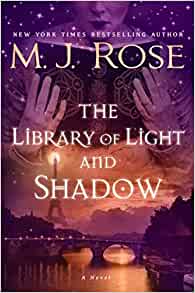
Sunday Review: The Library of Light and Shadow by M.J. Rose

NOTE: This got lost in my drafts folder, so this week, there are two reviews.

Because today is Halloween, I’m reviewing a book about magic, witchcraft, and love.

Descendant of a witch named La Lune, Delphine Duplessi has an unsetting talent of her own. While wearing a blindfold, she is able to draw portraits of her subjects that reveal their deeply hidden secrets. She supports herself in New York by creating such portraits as a party trick, only to have one such exhibition uncover a betrayal that leads to tragedy.

Horrified and consumed by guilt, Delphine returns to her home in the south of France and vows never to do another “shadow portrait,” as she refers to her blindfold creations. But France is no safe haven for Delphine. The reason she was in New York in the first place was that she fled Paris in terror because one of her visions revealed that she was going to cause the death of Mathieu, her one true love.

Recuperating from the New York incident in the house of her mother, also an artist and witch, Delphine rereads the journal she kept during her relationship with Mathieu and tries to fend off the pressure exerted by her twin brother and business manager, Sebastian, to return to doing shadow portraits. Eventually, she discovers that he too is in danger and reluctantly agrees to help him by creating shadow portraits, not of a person, but of a chateau where an ancient alchemical work called Book of Abraham is said to be hidden. The Duplessis’ client is Emma Calvé, a famous and charismatic opera singer who has searched for the work for years.

The novel is atmospheric and contains vivid descriptions. The post-World War I time period felt fresh and was perfect for the story. I found Delphine to be sympathetic and well developed.  The other main characters—Mathieu, Sebastian, Sandrine (the twins’ mother), Emma, and the enigmatic caretaker of Emma’s estate—are all complex and interesting.

As for the story’s premise, the idea of shadow portraits is both intriguing and disturbing. The mystery of the Book of Abraham has a surprising resolution.

However, I didn’t have unqualified enthusiasm for the novel. As much as I rooted for Mathieu and Delphine’s love, the flashbacks to their previous relationship began to lose my interest after a while. And the plot hinges on the interpretations of two pieces of ambiguous information that I was able to figure out very early. Overall, I would say this is a solid four-star effort. Note that this is the third in a series. I haven’t read the other two, but if you decide to read this and care about such things, the first installment is The Witch of Painted Sorrows.

Leave a comment

Filed under Book Reviews, Gothic, Historical fiction, Romance