Category Archives: France

Sunday Review: The Porcelain Moon by Janie Chang

Did you know that more than 100,000 thousand Chinese laborers worked in Europe doing support labor during World War I? Neither did I until reading Janie Chang’s historical novel The Porcelain Moon.

The novel tells a dual story, both tales set during WWI. Pauline is an illegitimate Chinese girl, being raised by an uncle who runs a shop that sells Chinese porcelain and artifacts in Paris. Her parents are both dead, and no one in the family but her uncle and his son Theo cares about what happens to her. Pauline is approaching the age when she will be forced back to Shanghai for a marriage arranged by Uncle’s wife, who despises her and has no reason to make a good match. Theo is also facing a dreaded arranged marriage, a prospect he delays by taking a job as an interpreter for the Chinese Labour Corps.

The other plot line concerns Camille Roussel, a young woman trapped in an abusive marriage to a man who is bent on making money from the war by any means available. Camille lives in Noyelles-sur-Mer, near one of the labor camps. When Pauline comes searching for her cousin, hoping Theo will help her avoid being sent back to China, the two young women meet and discover they share a bond that neither has suspected. A bond that involves a dangerous secret.

The spotlight this novel shines on the overlooked contribution Chinese laborers made to the war makes it worth reading. Unfortunately, I didn’t think the intertwined story of the two young women was really a strong enough vehicle for this important subject matter. Honestly, for the first half of the book, I had trouble keeping the two storylines separate in my mind. You’d think that having one character be French and the other Chinese would be enough of a distinction, but for much of the novel, both are victims trapped in difficult circumstances, so the two character arcs are too much the same. Each character also has a love story, neither of which I found compelling. And the ending was just a bit too easy for my taste.

I wish I could recommend this more strongly. I loved The Phoenix Crown, Chang’s collaboration with Kate Quinn and was eager to see what she’d produce on her own.

Leave a comment

Filed under Book Reviews, France, Historical fiction, Paris, Romance, Twentieth century, World War I

Sunday Review: The Great Believers by Rebecca Makkai

I really didn’t know what to expect when I started The Great Believers, but now I think it’s the best book I’ve read so far this year.

It’s a duel timeline novel. One story, set from 1985 to 1990, chronicles the tragic losses that occur when the AIDS epidemic reaches Chicago and begins to spread among the LGBTQ committee there—among the first generation to really experience the exuberance of living fully out and celebrating gay pride. The point of view character for this timeline is Yale Tishman, a thoughtful, quiet man who is trying to build a world-class gallery at Northwestern University and is in a relationship with Charlie Keen, who publishers a newspaper focused on LGBTQ issues. Early in this narrative, one of their best friends—Nico Marcus—dies of AIDS, forcing them all to face what is happening and make hard choices (or not, depending on the person). Yale remains close with Nico’s younger sister Fiona, who becomes a fierce advocate for all of Nico’s friends, especially those who find themselves navigating the isolating journey that is AIDS.

The second timeline features Fiona in 2015. She’s a divorced women, suffering from PTSD because of all the losses she endured in the 1980s, running a charity thrift store whose proceeds go toward AIDS work, and struggling with guilt because she’s estranged from her daughter, Claire, who not only rejected Fiona but also disappeared into a cult. Someone sends Fiona a video of a young woman in Paris who might be Claire, so Fiona takes off to that city to try to track her down. While there, she stays with a gay photographer friend she’s known since the 1980s, a man who is about to open a major exhibition that will feature some of the images from the past.

The book is warm, evocative, devastating, beautiful, and heartbreaking. Each character is so vividly drawn. I loved both Yale and Fiona, and I felt so deeply for their situations. Even though the author is much younger than the people she’s writing about, this all felt very authentic to me. Because I lived in Chicago during the 1980s and worked with people who did some AIDS awareness projects at our company, I could remember a bit of what that period was like, although my experience of it was definitely far removed from what the characters of this book went through. This novel made me wish I’d forced myself to know more, care more, and do more about the crisis.

I honestly want to run around telling everyone I know to read this novel. It affected me that deeply.

Leave a comment

Filed under American history, Book Reviews, contemporary fiction, fiction, France, Historical fiction, Paris, Twentieth century

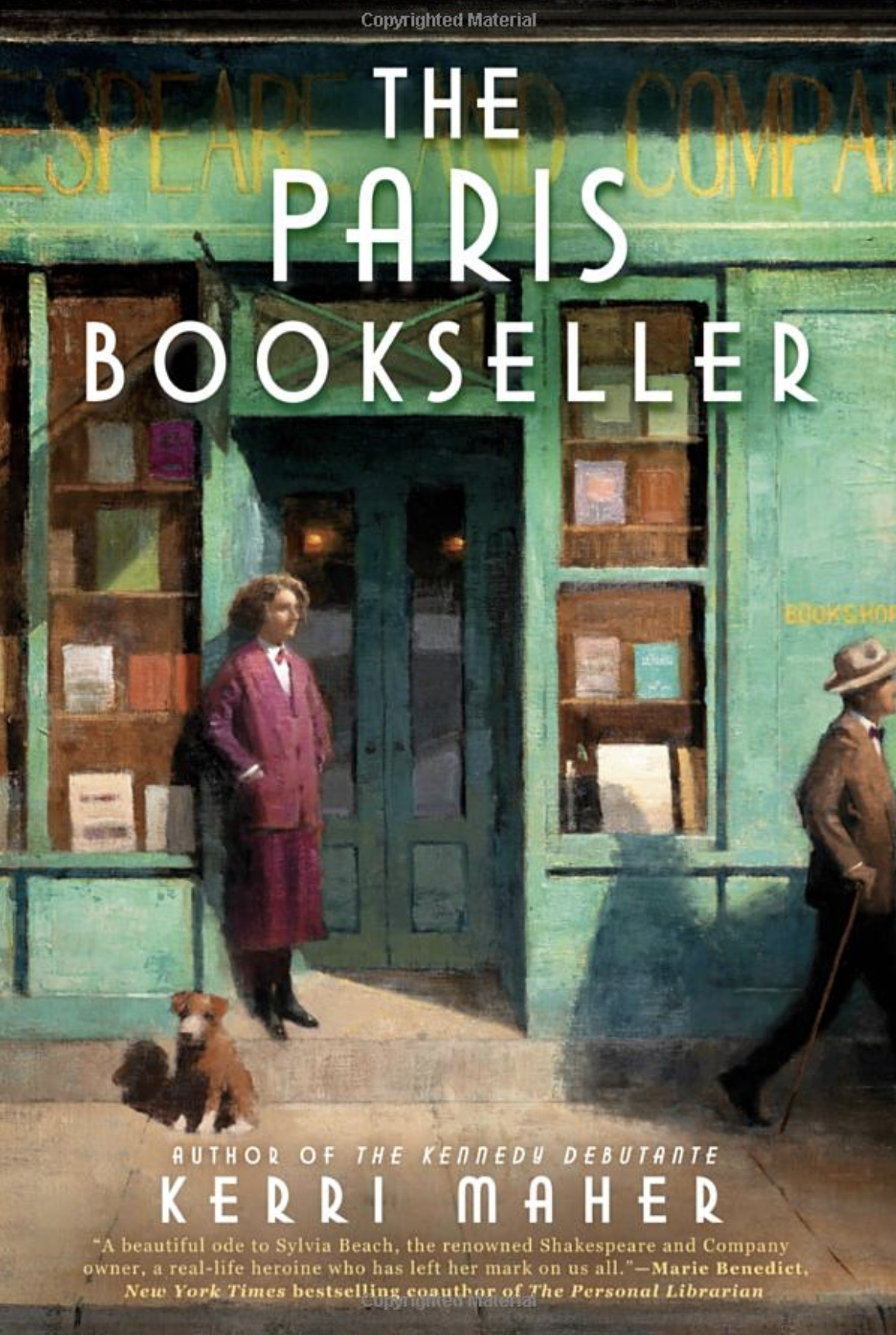
Sunday Review: The Paris Bookseller by Kerry Maher

This historical novel tells the story of Sylvia Beach, founder and owner of the famous Shakespeare and Company English-language bookstore in Paris. Although this is a single-timeline novel, there are a couple of important threads to the story: Beach’s love affair with the French bookstore owner Adrienne Monnier and her interactions with the writers and artists who flocked to Paris in the 1920s, most importantly James Joyce.

Beach knew Joyce at the time he was writing his masterpiece Ulysses. Excerpts had been published in literary journals, and Joyce’s frank depictions of bodily functions and human sexuality caused American officials to deem it pornography, making it a crime to sell or even send through the U.S. mails. Beach believed strongly in Joyce’s art, so she decided to publish the novel in Paris, even though she had never published anything before.

As portrayed in the novel, the relationship between Beach and Joyce is tremendously complicated. Joyce is grateful, in his own way, but he also has the kind of entitled personality that just accepts the things that other people do for him. One of the interesting questions of the story is this: does Joyce take advantage of Beach, or does Beach fail to stand up for herself? Or is their relationship an unhealthy combination in which both are true?

Other prominent literary figures wander through the pages, among them Ernest Hemingway, F. Scott Fitzgerald, and Gertrude Stein. Beach was more than just a bookstore owner; she promoted the groundbreaking literature of the time, and many people felt that she played a pivotal role in nurturing their careers.

Beach’s relationship with Monnier is beautifully depicted. The two women have a deep and abiding love, but as they live through legal hassles, economic hard times, and World War II, the stressors they experience affect them in different ways, and they begin to grow apart. I never lost my sympathy for either of them even when I wanted their choices to be different.

This is an excellent novel for lovers of Paris and of American letters.

Leave a comment

Filed under Book Reviews, France, Historical fiction, Paris, Twentieth century