Category Archives: fiction

Sunday Review: The Secret Keeper of Jaipur by Alka Joshi

I really enjoy well-written Indian novels. The country is so vast with an ancient history and a wide diversity of regions and peoples. A few years ago, I read and loved Alka Joshi’s first novel, The Henna Artist, the story of Lakshmi, a determined woman who fled a bad marriage and found a way to use her knowledge of herbal remedies and the art of henna painting to support herself, a servant boy named Malik, and the sister who showed up unexpectedly on her doorstep. (The premise grabbed my interest right away because when I was in my late twenties, I attended the wedding of a beloved Afghan friend and got to experience having my hand painted with henna before the ceremony.)

This week, I read The Secret Keeper of Jaipur, which is a sequel to the first novel. Set 12 years after The Henna Artist, it focuses on Lakshmi and most especially Malik. The novel grabs the reader’s attention right away; 20-year-old Malik is in Jaipur learning the construction business from the renowned Singh-Sharma Construction Company, which has been building a world-class cinema for the Maharani Latika of Jaipur. At the grand opening, a disaster occurs when the balcony collapses, killing several people.

The novel then backtracks two months to allow readers both to catch their breath and to catch up with what’s happened to Malik, Lakshmi, and her sister Radha in the intervening years. Malik is now in love with a young woman who is every bit as strong, self-sufficient, and determined as Lakshmi. She’s also a recent widow who comes from a tribe of nomadic hill people, and she has two young children. Lakshmi is not at all sure this is the right partner for her protegé.

Then there is the mystery of why the building collapses. Inquisitive, streetwise Malik is the only person who doubts the official explanation, and he may be the only one who can save family friend Manu Agarwal from unjustly taking the blame for shoddy workmanship.

I recommend the book highly, as I do its prequel. It isn’t absolutely necessary to read the two in order, although the second book does contain some spoilers for the first. (P.S. Isn’t the cover absolutely gorgeous?)

Leave a comment

Filed under Book Reviews, fiction, Historical fiction, Indian fiction

Surprising Research: Returning the World War II Military Dead

While working on a chapter that deals with the death of my main character’s uncle in the Italian campaign during World War II, I decided to look up how long it took to bring back the bodies of dead members of the U.S. military. Having grown up during the Vietnam War and seen the televised footage of caskets returning home, I assumed that it might take a few weeks or months at most. But the answer stunned me. The United States did not bring home the first shipment of World War II dead until October 1947, a full two years after the war ended.

More than 400,000 U.S. military personnel died during the war. The government offered the surviving families two burial options: 1) they could choose to have their loved ones buried in an overseas military cemetery, or 2) they could ask to have to the remains returned to the United States for burial.

World War II was a much more widespread and complicated conflict than any the United States had fought before; battlefields ranged across Europe, Africa, and Asia. The government realized that because the dead were found in such far-flung regions—and because not all of those places would be in friendly hands at war’s end—it was likely that many more families would want their loved one’s remains returned than had occurred after the end of World War I, which took place primarily in Europe.

Not all the dead were recovered. The remains of more than 280,000 Americans were found. (Some are still being found.) As it turned out, more than 171,000 families chose repatriation. In a little more than three-quarters of those cases, those who died were buried in private cemeteries, with the rest being eligible for burial in national cemeteries.

Why did it take so long to return the bodies?

  • First the war had to be won. The government had a policy against transporting remains while the conflict continued.
  • Second, after hostilities ceased, the military had an enormous job to get the live troops back home safely.
  • Third, recovering the bodies of the fallen, buried in temporary graves around the globe, was in itself a logistical nightmare.
  • Fourth, the government had to contact all the families of the dead to learn their wishes. The questionnaires did not go out to the families until 1946, and then the government had to compile the results so it would know what to do in each case.

Next week, I will write about the process of bringing the remains home.

3 Comments

Filed under American history, fiction, Historical fiction, Research, Writing Historical Fiction

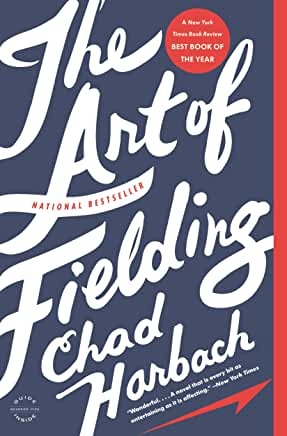
Sunday Review: The Art of Fielding by Chad Harbach

I’ve been interested in this novel since it was published ten years ago but somehow never got around to reading it until now. 

The Art of Fielding is the name of both this novel and a book within the novel, a manual about how to be an excellent fielder written by the fictional Hall of Fame shortstop Aparicio Rodriguez. Snippets from this guide—which range from technical advice to Zenlike wisdom to a lover’s obsessive paeans—appear throughout the novel, particularly in the beginning. 

At first, it’s easy to assume that the story is primarily about Henry Scrimshander, who’s read the guide so often he can recite it. But Harbach doesn’t have such a narrow focus in mind. It quickly becomes apparent that there are five equally important protagonists to this story:

  • Henry Scrimshander, a teenaged baseball phenom reminiscent of The Natural’s Roy Hobbs
  • Mike Schwartz, the college sophomore catcher who spots Henry’s talent and recruits him for the Westish College team of which Mike is the driving force
  • Owen Dunn, Henry’s college roommate, a scholarly, gay, biracial student with a normally unflappable personality
  • Gwert Affenlight, the handsome charming president of Westish College, who used his own obsession with Herman Melville to reshape the college identity
  • Pella Affenlight, Gwert’s brilliant but rebellious daughter who dropped out of high school to marry a forty-something architect, a relationship that sent her into deep depression and eventually back home

Like The Natural, this is a baseball story that’s about much more than our national sport. These five people are on a collision course that leads to unexpected romantic pairings and re-pairings. More importantly, several of them confront personal crises that force them to reevaluate what they really want. The themes of obsession, self-destruction, self-knowledge, personal responsibility, and the possibility of redemption are integrated throughout the story. 

I thoroughly enjoyed it and only wish I hadn’t waited so long. 

Leave a comment

Filed under Book Reviews, fiction

New Review of Katie, Bar the Door

The following review by senior reviewer Diane Donovan just appeared in the November issue of MBR Bookwatch:

It’s rare that the title of a book proves original and compelling in and of itself, but Katie, Bar the Door is such a creation. It will appeal to readers of modern women’s fiction with its astute story of Katie Thompson, a first-person story which captives not only by its title, but in its first few lines: “I felt as though I were being driven to a sentencing, not my wedding.”

Katie harbors big dreams for her future which do not embrace the conventional paths others around her believe she should follow.

In the opening lines of her story, she and Ritchie have eloped, and are to be married without benefit of ceremony. The couple has known each other since childhood. Forbidden from embarking on this relationship by a strict mother who caught them necking, Katie’s taken the step into sexuality, and is the driving force behind insisting that they now marry.

The reason, however, isn’t for love. It’s because of lack of options: “Even if I got to a phone and reached my mother, I wasn’t sure she’d take me back. She had forbidden my relationship with Ritchie over a year ago after she caught us necking and told me that, in God’s eyes, I was as guilty as if I’d slept with him. Defying her low opinion of me, I had clung stubbornly to my virginity until we ran away, surrendering it then only because of the promise that I’d be Mrs. Richard Pelletier in the morning – and because Ritchie’s rage at being asked to wait one more day was too menacing to defy. Now that the deed was done, according to the stringent doctrines of my mother and my church, my only chance to redeem myself was to marry the partner of my lust.”

As Katie faces domestic violence, being a runaway from her family and faith, and reviews dead-end roads and future options, readers journey alongside her as she faces a series of men who become bosses, lovers, and potential protectors, unified in their desire to control her in some way.

Even her professor, Dr. Peter Taylor, becomes entangled in Katie’s life and dreams as she moves from a history student in his class to something more.

Katie rewrote a history paper when she realized that her facts and sources were outdated. Can she rewrite her life?

Ruth Hull Chatlien crafts a vivid story of abuse, growth, repression, and changing perceptions and attitudes as she documents a young woman’s journey to self-empowerment and self-realization.

As the story moves full circle to embrace the relationships between mother and daughter and generations of belief, readers receive an engrossing examination of how past memories and experiences transform into future changes and new possibilities.

Katie, Bar the Door takes no simple paths in exploring these revelations. It provides many twists and surprises that will delight readers interested in a moving story of a young woman’s dreams, misconceptions, and growth. It will appeal to those interested in emotional trauma, recovery, and transformation, as well as in evocative women’s fictional writings.

You can order it here.

Leave a comment

Filed under Book Reviews, fiction

Sunday Review: Mexican Gothic by Silvia Moreno-Garcia

In this week before Halloween, I’ve decided to post a review for a book I read a few months ago: Mexican Gothic. Set in the 1950s, the novel takes a classic gothic plot line but transports it to Mexico—a young woman travels to a mysterious house and uncovers a secret horror that ends up threatening her life and freedom.

Noemí Tabada is a popular and charming debutante in the highest levels of Mexican society, known for her beautiful clothes and many admirers. When her recently married cousin Catalina sends a letter home describing bizarre and dangerous happenings in her new husband’s family estate, Noemí’s father sends her on a mission to see if Catalina is losing her mind. When she first arrives, Noemí has a difficult time finding anything wrong, except that no one wants to let her spend time alone with the cousin she came to see.

Of course, things don’t stop there. Noemí begins to have terrible nightmares and to suspect that something is very, very wrong beneath the surface. I won’t say more because I don’t want to spoil the book’s effect.

To be honest, when I read it, I struggled with my reaction to this novel. Parts of it are incredibly disturbing and distasteful, but … that’s kind of the point. In the end, I came to see it as an exploration of the survival instinct. On the one hand is one person’s deformed survival instinct, grown bloated, diseased, and parasitical, which fuels all the weirdness. On the other hand is the main character’s strong but still-within-the-bounds-of-reason survival instinct, fueled by courage, love, and her own indomitable will. I’m glad I read it, but the last section of the novel is not for the faint of heart.

Leave a comment

Filed under Book Reviews, fiction, Gothic, Historical fiction

Sunday Review: The Limits of Limelight by Margaret Porter

I’m a lifelong fan of old movies, so when I learned that Margaret Porter was writing a novel about Phyllis Fraser, Ginger Rogers’s cousin, I was eager to read the book and bought it soon after it was published. Phyllis, born Helen Nichols, was an Oklahoma City high school student when her cousin and aunt cooked up a plan to bring her to Hollywood and make her a star. I was intrigued because, although I’ve seen countless Ginger Rogers movies, I’d never heard of her younger cousin.

There’s a good reason for that. Although Phyllis finds fairly steady work as an actress because of her family connections, she doesn’t achieve anything like the status of her more-famous relative. Even so, her story is quite interesting. She becomes part of a group of “baby stars,” hopeful starlets being groomed by the studio yet struggling to break out of the pack. One of her closest friends was Anne Shirley, the former Dawn O’Day who changed her name to match that of the most famous character she portrayed. Anne pursues romance with a handsome actor as well as success on screen. Then there is Peg Entwistle, an ethereal English beauty who longs to return to to the Broadway stage and whose fate has become Hollywood legend (read the novel to find out why). Katharine Hepburn also wanders in and out of the story, first as a rival who feuds with Ginger Rogers and then as someone trying to shed her reputation as “box office poison.”

Phyllis is a refreshingly down-to-earth girl, called “Oklahoma wholesome” by one of her many suitors. Although she enjoys the Hollywood social scene, she has few illusions about the depth of her talent nor does she let any young man, no matter how charming, rush her into a relationship she’s not ready for. Before moving to Hollywood, she had non-acting career goals, and as she gradually learns that the lure of limelight has its limits, she must decide whether to continue pursuing acting or to try building a reputation in a completely different field.

Ginger Rogers and her mother Lela are strong presences in the novel. Lela, who had served in the Marines during World War I is a daunting personality who serves as her daughter’s manager and fights for Ginger’s career with relentless determination. Ginger—the ultimate quadruple threat, a massively talented performer who sings, dances, and acts in both comedy and drama—is ambitious and hard working. She’s less successful in her romantic life, as the novel makes abundantly clear.

The book is an enjoyable fast read, perfect for TCM subscribers and students of Hollywood history. The characters are well drawn and vidid. Phyllis herself is likable, and I found that the path she eventually chooses provides a satisfying ending to the novel.

Leave a comment

Filed under Book Reviews, fiction, Historical fiction

Sunday Review: The Madness of Crowds by Louise Penny

Although I am a longtime fan of Louise Penny’s Armand Gamache series, over the last few years I’ve felt less enthusiastic about some of the books. I know that it’s very hard to keep a series fresh, but the pivot to having several plots about massive conspiracies didn’t appeal to me as much as her earlier work. (Your mileage may vary.)

With this novel, I think Penny struck a better balance. First, it’s set back in Three Pines, so we get to catch up with the cast of eccentric characters there. Second, the issues she explores juxtapose a debate over policies that would have national significance with the moral cost to individuals of participating in or fighting against those policies. (I am being deliberately vague to avoid spoilers.) Several characters come face to face with shadowy things hidden in their own psychological depths—reasons for their behavior that they would prefer not to admit. This isn’t unusual in a Louise Penny novel, but I found these revelations particularly poignant. 

This is one series I strongly recommend reading in publication order. And I do still recommend it. Because of this latest installment, I am looking forward again to the next Gamache book. 

Leave a comment

Filed under Book Reviews, fiction

A Visit with Anna Belfrage

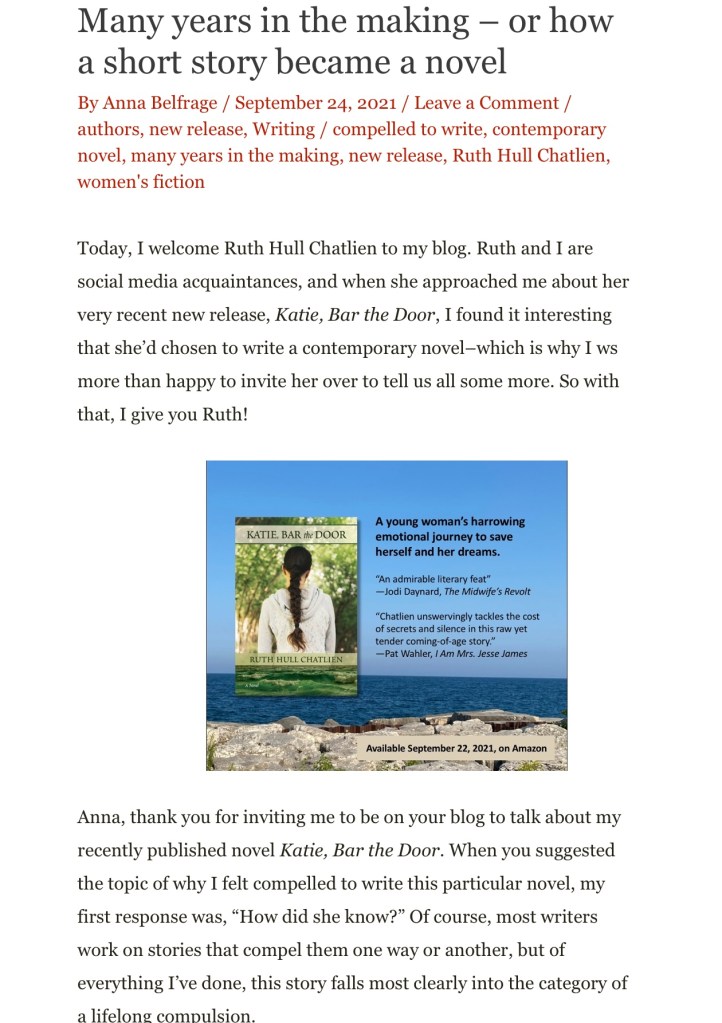
I did a guest post on Anna Belfrage’s blog yesterday. We became acquainted on social media through our network of historical novelists. To read the post, you can click here.

Leave a comment

Filed under fiction, Uncategorized, Writing

Release Day: Katie, Bar the Door

cover of Katie, Bar the Door

Today is publication day for my third novel—Katie, Bar the Door, a work of contemporary women’s fiction.

You can order the book in Kindle or paperback here: https://bit.ly/order_KBtD (The Kindle is live now; the paperback will be up in a day or two.)

Summary: From a childhood of parental loss, religious repression, and sexual shaming, Katie Thompson suffers deep wounds and persistent self-doubt. Her desire to find meaning through education and a career is threatened by those who push her to conform to a more traditional path. In her desperate search for love, Katie makes disastrous choices about men, leading her to the brink of self-destruction. Her journey through Katie, Bar the Door is the universal quest for healing and hope as she struggles to save herself and her dreams.

ADVANCE PRAISE

“The full circle of love, loss, and forgiveness left me with a great deal of hope and heart-swell.”—Kelly Fumiko Weiss, Windy City Reviews

“An admirable literary feat”—Jodi Daynard, The Midwife’s Revolt

“Tackles the cost of secrets and silence in this raw yet tender coming-of-age story”—Pat Wahler, I Am Mrs. Jesse James

“A gut-punching, white-knuckled labyrinthine tale of Katie’s tormented, guilt-ridden passions”—Nina Romano, The Girl Who Loved Cayo Bradley

“Manages to offer the reader both deep psychological insight and a page-turning narrative”—Barbara Monier, The Rocky Orchard


Radio Interview with Susan Wingate

To mark the book launch, I was interviewed toady on blog talk radio by the fabulous Susan Wingate. Click on the image to go to the interview.

Leave a comment

Filed under fiction, Writing

Sunday Review: Book Woman of Troublesome Creek

Kim Michele Richardson’s The Book Woman of Troublesome Creek is a beautiful example of a historical novel that sheds light on a little-known aspect of American history. Frankly, I wish publishers would look for more stories like this instead of endlessly bringing out books about the world wars.

This story focuses on two aspects of Kentucky’s history: first, the pack horse librarians who at some danger to themselves carried books and magazines into some of the poorer regions of the Kentucky hills and, second, the blue people of Kentucky, whose unusual color was caused by a recessive genetic condition and which caused them to be discriminated against in much the same way Black citizens were.

Richardson herself is a native of Kentucky, and she conveys an especially strong sense of the place and culture. Cussy Mary is a likable narrator, spunky without being overly modern. Through Cussy’s father, the story also highlights the hardships of Kentucky coal miners.

The book has a satisfying but not too saccharine ending and an epilogue that explains more about the historical background. I enjoyed the novel very much.

Leave a comment

Filed under Book Reviews, fiction