Category Archives: American history

Sunday Review: Red Clay, Running Waters by Leslie K. Simmons

Many of us know at least a minimal amount about the tragic Trail of Tears, in which the U.S. government forced the Five Civilized Tribes of the Southeast (Cherokee, Chickasaw, Choctaw, Creek, and Seminole) to leave their ancestral lands and move to the Indian Territory (now the state of Oklahoma) west of the Mississippi River. Thousands died during the journey.

What is less known are the events that led up to this calamitous outcome. In her biographical novel Red Clay, Running Waters, Leslie K. Simmons provides an in-depth look at how the Cherokee fought to retain their homeland by focusing the story on one important figure: Skaleeloskee, known to history as John Ridge. The son of a Cherokee leader, John was sent from his home to a mission school in Connecticut at the age of 16. He excelled at his studies and became an accomplished orator. He also fell in love with Sarah Bird Northrup, the white daughter of the school’s steward.

In the 1820s, a relationship between a native man and white woman was controversial, and the young couple’s desire to marry creates a firestorm of opposition. However, the two had formed a deep bond, forged in part because of their attraction to each other but more importantly because of shared ideals. Simmons excels at portraying their love, both in the beginning infatuation stage and over the course of time. After persisting for two years, John and Sarah finally were allowed to marry in 1824. The prejudice and discrimination they faced because of their relationship was merely a foretaste of what was to come.

Sarah traveled with John to Georgia to live in the Cherokee Nation, which stretched across parts of Tennessee, Georgia, and Alabama. The Cherokee were in the process of developing a constitutional government similar to that of the United States. John became a member of the National Council. However, because of Americans’ lust for good farmland and the 1828 discovery of gold in Georgia, the United States began to pressure the Cherokee to cede their homeland and move.

One mistake whites often make when thinking of native peoples is assuming that they are somehow monolithic in their thinking and in their attitudes toward whites. As I learned while writing my own novel Blood Moon: A Captive’s Tale, that is often not the case. Factions existed among the Cherokee with strongly held, opposing opinions about how to deal with the U.S. government’s demands. John, supported by Sarah, fought hard for what he thought would be the best solution, but equally passionate leaders argued for other outcomes.

Simmons portrays the conflict in detail in her novel. The arguments were complex, and some of the people involved were inconsistent and at times devious. Although highly educated and skilled at both writing and speaking, John wasn’t always trusted by more traditional Cherokee who viewed him as “too white.” The situation in the novel vividly shows the dilemma often faced by native peoples: do they adopt white ways to gain tools to help fight for their people, or is the cost too high in the loss of their culture and perhaps legitimacy in the eyes of their people?

This novel will be especially appreciated by readers who enjoy policy debates and situations with multiple shades of grey rather than a clear blank-and-white outcome.

Leave a comment

Filed under 19th century life, American history, Cherokee, Historical fiction, Native American, Trail of Tears

Sunday Review: The Orchid Hour by Nancy Bilyeau

This intriguing novel is set in New York City in 1923. Prohibition has been the law of the land for just a few years—but long enough for mobsters to have established black market supply lines and set up speakeasies throughout the city.

The main character, Zia De Luca, is not the kind of person you’d expect to be mixed up in this kind of racket. She’s a Sicilian immigrant, yes, but she’s also a war widow who has a young son and works in a branch of the New York Public Library on weekdays and in her father-in-law’s cheese shop on weekends. On the other hand, her favorite cousin Salvatore has shady connections and a questionable reputation, so she’s closer to the Cosa Nostra than the proverbial six degrees of separation.

Then three things happen to catapult Zia into her cousin’s shadow world. First, a quiet patron who’s asked her to translate a Sicilian play is shot to death outside the library; the police question Zia about their conversations. Second, she’s laid off from her job because of budget cuts, leaving her wondering how to realize her dream of saving for her son to attend college someday. Finally, her father-in-law is murdered in his store by a man masquerading as a reporter who wants Zia’s story.

Realizing that the police do not see a connection between the two crimes—and observing that they show little interest in investigating either—Zia decides to go undercover working in her cousin’s new speakeasy, an elegant nightclub named the Orchid Hour, appropriately hidden behind a florist’s shop.

The settings of the book—from the speakeasies to the neighborhood of Little Italy—are filled with vivid sensory details. (You can’t read this book without craving authentic Italian lasagna or Lindy’s famous cheesecake, or perhaps wishing you could go to the Orchid Hour to hear the trio of Russian emigré muscians!) The story abounds with colorful characters: from Salvatore Lucania (later to go down in history as Lucky Luciano), to the fictional actor David DaCosta (rival to the great Valentino), the beautiful half-Sicilian Ziegfeld Follies performer Julia Morel, the intrepid and determined Zia herself, and even a cameo by J. Edgar Hoover.

The plot has enough twists and turns to satisfy any devotee of historical mysteries. I recommend the novel and rate it five stars.

Leave a comment

Filed under American history, Book Reviews, Historical fiction, Twentieth century

Sunday Review: The Great Believers by Rebecca Makkai

I really didn’t know what to expect when I started The Great Believers, but now I think it’s the best book I’ve read so far this year.

It’s a duel timeline novel. One story, set from 1985 to 1990, chronicles the tragic losses that occur when the AIDS epidemic reaches Chicago and begins to spread among the LGBTQ committee there—among the first generation to really experience the exuberance of living fully out and celebrating gay pride. The point of view character for this timeline is Yale Tishman, a thoughtful, quiet man who is trying to build a world-class gallery at Northwestern University and is in a relationship with Charlie Keen, who publishers a newspaper focused on LGBTQ issues. Early in this narrative, one of their best friends—Nico Marcus—dies of AIDS, forcing them all to face what is happening and make hard choices (or not, depending on the person). Yale remains close with Nico’s younger sister Fiona, who becomes a fierce advocate for all of Nico’s friends, especially those who find themselves navigating the isolating journey that is AIDS.

The second timeline features Fiona in 2015. She’s a divorced women, suffering from PTSD because of all the losses she endured in the 1980s, running a charity thrift store whose proceeds go toward AIDS work, and struggling with guilt because she’s estranged from her daughter, Claire, who not only rejected Fiona but also disappeared into a cult. Someone sends Fiona a video of a young woman in Paris who might be Claire, so Fiona takes off to that city to try to track her down. While there, she stays with a gay photographer friend she’s known since the 1980s, a man who is about to open a major exhibition that will feature some of the images from the past.

The book is warm, evocative, devastating, beautiful, and heartbreaking. Each character is so vividly drawn. I loved both Yale and Fiona, and I felt so deeply for their situations. Even though the author is much younger than the people she’s writing about, this all felt very authentic to me. Because I lived in Chicago during the 1980s and worked with people who did some AIDS awareness projects at our company, I could remember a bit of what that period was like, although my experience of it was definitely far removed from what the characters of this book went through. This novel made me wish I’d forced myself to know more, care more, and do more about the crisis.

I honestly want to run around telling everyone I know to read this novel. It affected me that deeply.

Leave a comment

Filed under American history, Book Reviews, contemporary fiction, fiction, France, Historical fiction, Paris, Twentieth century

Sunday Review: The Next Ship Home by Heather Webb

The Next Ship Home is an enlightening and enjoyable novel about Ellis Island at the very beginning of the 20th century. The two protagonists seem, at first glance, to have little in common. Alma comes from a German family that is well established in New York. Her mother and stepfather run a popular beer hall in a largely German area, but the family is saving to move to a better neighborhood. However, Alma’s life is not as rosy as it might at first seem. She is plain and studious, and she has neither managed to marry nor attract potential suitors. Her stepfather resents her for being a “financial burden” on him, so he arranges for her to work as a matron on Ellis Island.

There, Alma joins an overworked and often resentful staff—and she finds troubling evidence that immigrants are not being treated with the respect, kindness, and helpfulness they deserve. Early in her employment, she befriends two Italian sisters, Francesca and Maria, who are fleeing an intolerable situation in Sicily. In her insular German-American community, Alma has been taught that Italians—and Sicilians in particular—are criminals who are little better than animals. Her growing friendship with Francesca, who wants only to get a job so she can build a new life, forces her to rethink those prejudices.

At the time the novel is set, 1902, the press and the government were trying to uncover abusive and fraudulent practices taking place at the famous port of entry for so many immigrants. Alma and Francesca get caught in the middle of the explosive situation and must make a difficult choice between ignoring the wrongdoing or confronting it at the risk of their own wellbeing. Francesca in particular faces potentially disastrous consequences; the novel’s title names the very threat that hangs over her head if she angers the wrong people.

The characters are well-drawn, the plot never lags, and the background about Ellis Island is interesting and appalling in equal measure. Highly recommended.

Leave a comment

Filed under American history, Book Reviews, Historical fiction, Twentieth century

Don’t Assume!

Korean War Veterans Memorial in Washington, D.C.

Today’s lesson in being a historical novelist is “Don’t assume anything.”

In my novel-in-progress, I have a character whose older brother has to serve in the Korean War. And because my character is going to talk about what’s going on to his girlfriend (my main character), he (and therefore I) have to know the facts. Because sure as shooting (excuse the pun), if I have one of the following details wrong, someone somewhere is going to shred the book in a review or in an incensed email to me.

– When did young men have to register for the draft? I assumed 18. In this, I was correct.

– When did young men have to go for their preinduction physical to be assigned their draft status? At first, I assumed 18. In this, I was wrong. Initially for Korea, it was 19. Later, they lowered it to 18-1/2 because they needed more men. Tommy (my guy) was still in the 19-year-old time period.

– How long was basic training? At first, I assumed it was the same as during WWII. Wrong. Someone in the government got the brilliant idea to shorten it, just train recruits in “camp life” stateside, and let the officers in Korea train the recruits in combat conditions … while they were undergoing combat. It didn’t work out so well (I wonder why), so they revamped the program for Vietnam. (This applies only to U.S. troops, not the rest of the countries making up the UN forces in Korea. The Brits, for one, had more sense.)

– Where would someone recruited from Illinois do his basic training? Silly me, I thought it was obvious that someone from Illinois would go to Fort Leonard Wood in neighboring Missouri. But remember today’s lesson. Don’t assume. So today I spent more than two hours trying to answer this question definitively. There are lots of written and recorded histories by Korean War vets on the Internet. The trick was finding one that would tell me a) where the soldier was from and b) where he did his basic training. I finally found a site that allowed me to sort by state (Illinois) and by topic (basic training). And I found five relevant video interviews. Turns out that each one of the KW vets was trained at a different place: Camp Breckinridge, KY; Fort Leonard Wood, MO; Fort Bliss, TX; Fort Bragg, NC; and Fort Bennington, GA.

Fortunately for me (or I’d still be searching), one of the interviews was with a man who was the right age (give or take a couple of months), who was drafted just a couple of months after my guy, and most importantly, served in a division of the 8th U.S. Army that actually fought in the battle where I need my guy to be. Which means Tommy gets to be shipped down to El Paso, TX, for training. Yay.

Also fortunately for me, I’ve already discovered how long troop ships took to sail from San Francisco to Korea: two to three weeks. Putting everything together, I now know that poor Tommy will be in Korea fighting in time to be captured during the Battle of the Soyang River.

That’s the other lesson about historical novelists. We have no heart when it comes to our characters’ fates. Especially the minor ones.

2 Comments

Filed under American history, Historical fiction, Research, Twentieth century, Writing Historical Fiction

Sunday Review: The Social Graces by Renée Rosen

The Social Graces tells the story of the rivalry between two women, a generation apart, who led New York Society in the late 1800s.

Caroline Schermerhorn Astor was known as THE Mrs. Astor. If you weren’t among the 400 socialites invited to her annual ball or her summer clambake in Newport, RI, you simply weren’t part of the elite. And people with “new money”—the railroad barons, etc.—didn’t have a prayer of receiving one of her coveted invitations. That is, until determined, clever Alva Vanderbilt came along.

This sharp dichotomy between old and new money is tremendously ironic. The founder of the Astor fortune, the first John Jacob Astor, was hardly a cultivated person. I describe him this way in my first novel, The Ambitious Madame Bonaparte:

Astor was a short man with dark blond hair, drooping brown eyes, and a large pointed nose. He spoke English with a German accent, and his manners were nearly as rough as the fur trappers who had made his fortune, but Betsy liked him because they shared the traits of ambition, determination, and practicality.

To be honest, I wasn’t sure how much I’d like a novel about two wealthy, privileged women competing to be the queen of New York society. However, I thought that, in their separate narratives (each has third-person point-of-view chapters threaded throughout the book), Rosen dramatized enough of the heartbreaks they endured and the life lessons they learned to convey their essential humanity. Both women make terrible mistakes with regard to their children, but in this portrayal at least, I never doubted their good intentions. (I’ve read enough other accounts of Alva Vanderbilt to wonder if Rosen was perhaps being too kind.)

Rosen made one other choice in the novel that I absolutely loved. Two of my favorite pieces of literature—the short story “A Rose for Emily” by William Faulkner and the poem “Richard Cory” by Edwin Arlington Robinson—share an unusual characteristic: both are narrated by the collective voice of the community in which the main character lives. I have always felt this modern version of the Greek chorus adds a unique perspective and have wished that more authors would make use of the technique.

Well, Rosen has a third voice to her narrative, in addition to the focusing closely on the lives of each woman. She has chapters narrated by “society” that give the collective opinion on the actions of Caroline Astor and Alva Vanderbilt. The last word, so to speak. This device reveals more of the broader impact of the two women, and I found it very effective.

Leave a comment

Filed under 19th century life, American history, Book Reviews, fiction, Historical fiction

Sunday Review: Booth by Karen Joy Fowler

This is the first book of Fowler’s I’ve read, and I didn’t know what to expect. I checked it out of the library because learning more about the famous, or infamous, Booth family intrigued me.

For those who don’t know, John Wilkes Booth, the man who assassinated Lincoln, was a younger son of a famous family of 19th-century Anglo-American actors. Their father, Junius Brutus Booth, was highly acclaimed as was John’s older brother Edwin. Another brother, Junius Jr., was also an actor although not as highly regarded. I already knew from past research that during the Civil War Edwin actually saved the life of Abraham Lincoln’s oldest son, Robert—an event that can truly be described as stranger than fiction. So I wondered what other surprising things I might learn about the Booths.

The book is divided into sections offering the point of view of different members of the family, including sisters Rosalie and Asia and brother Edwin. In the author’s note at the end, Fowler tells us that although Rosalie existed, almost nothing is known about her—her existence in the surviving family records is summed up by the repeated epithet “poor Rose”—so that narrator is an almost entirely fictional creation. In Fowler’s hands, she is old-fashioned, less gifted than her creative siblings, unusually close to her mother, haunted by the memory of the many brothers and sisters who died young, and in constant pain from worsening scoliosis.

Asia is devoted to her family, particularly her brothers. To her, being a Booth is everything, so she plans to chronicle the careers of her thespian father and brothers. Yet, she is unconventional in her own way and provides an entirely different perspective on the Booth tribe than her much older sister does. Asia is the one who most represents what it is like to adore a relative who later commits a monstrous public crime.

Edwin is the Booth most haunted by the legacy of the family patriarch. As a boy, he was charged with accompanying his father on tour and trying (impossibly) to keep him from drinking. Edwin longs without much hope for Junius Sr. to acknowledge him as the heir best equipped to carry on the Booth acting legacy. These family obligations and his own personal failings oppress Edwin for years, along with a growing rift with John, who becomes increasingly radical as the war marches to its bloody end.

This then is the family that produces the assassin who became perhaps the most vilified American of the late 1800s. The book sustained my interest throughout; the shifting points of view provide sometimes contradictory opinions that help show what a tangle it can be to sort out what goes into the making of a killer.

My main complaint, however, is that the novel felt to me more like an intellectual exercise rather than an emotional journey. I remained largely unmoved even by the end of the story, and for that reason, I feel that the book falls short of the great novel it might have been.

Leave a comment

Filed under 19th century life, American history, Book Reviews, Historical fiction

Sunday Review: The Masterpiece by Fiona Davis

Fiona Davis specializes in writing historic fiction about well-known buildings in New York City, and I have loved several of her novels. This time she focuses on Grand Central Station. The Masterpiece is a dual-timeline story set in the late 1920s and the mid-1970s.

The 1920s timeline focuses on Clara Darden, a young artist from Arizona who came to New York to study at the Grand Central School of Art. (Did you know there was once an art school on one of the upper floors of Grand Central? I didn’t.) Now working there as an instructor, she has to fight against two kinds of bigotry—sexism and the ingrained belief that illustrators are less-talented and less-important than “serious painters.” She meets and becomes involved with two very different men: a wealthy young poet and a fiery experimental painter from Armenia. Little do any of them know that the high life of the 20s can’t last forever; the economy is heading for a crash that will turn the country upside down and make art a dispensable luxury in a grim new world of standing in soup lines and making do with frayed, years-old clothing.

The 1970s story focuses on Virginia Clay, a women who is recently divorced and struggling to support herself and her daughter. She fails to qualify for the secretarial job she interviews for and ends up working at the Grand Central information booth. By this time, the depot is dirty and neglected—no longer the beautifully decorated showplace it was in the 1920s—and it’s home to drug addicts and other unsavory types, causing passengers to spend as little time there as possible. The building is in danger of being torn down, with only the lower sections incorporated into amuch larger structure.

One day, Virginia happens upon the abandoned art school and discovers a long-forgotten painting that speaks to her deeply. It also reminds her of a painting she saw in a magazine: a piece of art by the painter using the pseudonym Clyde, which is about to go on auction for a fortune.

The art school is the obvious tie between the two storylines, but as Virginia works to both save Grand Central and uncover the truth about the painting she found, more links between the two stories emerge. I found this a very enjoyable read.

Leave a comment

Filed under American history, Book Reviews, Historical fiction, Twentieth century

Sunday Review: A Woman of Intelligence by Karin Tanabe

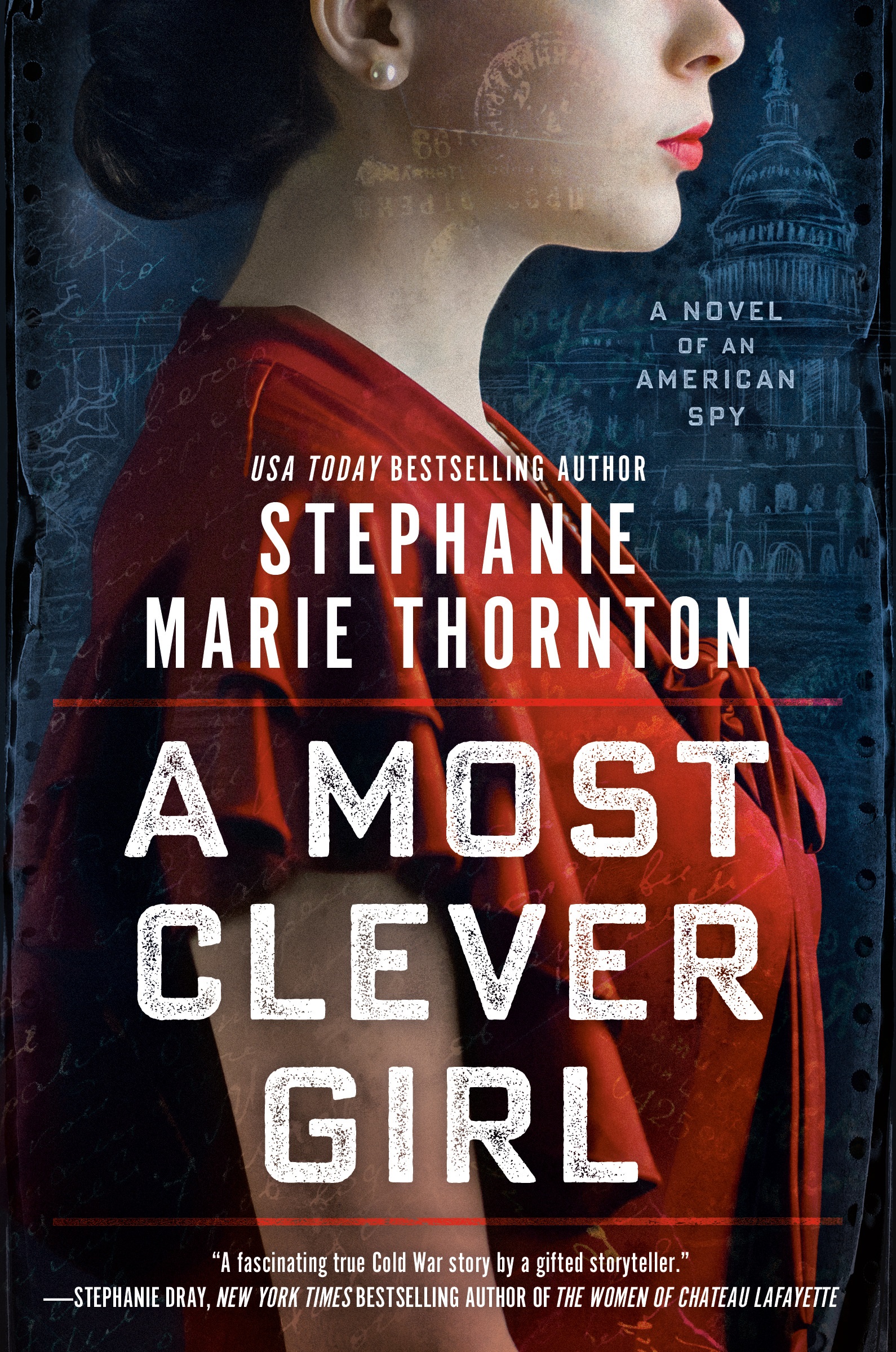
This novel seemed like an appropriate choice to follow up Stephanie Marie Thornton’s A Most Clever Girl because both deal with women in the intelligence game in mid-twentieth century United States. The premise intrigued me enough to overlook my qualms about the cover image: “It’s stunning,” I thought, “but that outfit is more 1962 than 1952.” In this case, I absolutely should have judged the book by its cover. The story never felt authentic to me.

Katharina, the daughter of immigrants, grew up speaking four languages and has since become conversational in at least one more—Russian. The novel opens in the early 1950s with Katharina and a friend watching their very young children in Central Park. The friend seems to have taken to motherhood effortlessly; she’s calm, empathetic, and decisive in dealing with her daughter and any crises that arise. In contrast, Katharina is easily overwhelmed by her rambunctious toddler and crying baby.

Once her “present-day situation” is established, we go back in time to her life just after World War II. Because of her skill set, Katharina gets a job as a simultaneous translator at the UN (similar to Audrey Hepburn in the movie Charade, which is one of my all-time favorites, so I was intrigued). However, from the start, I found it hard to relate to Katharina. Even though she mentions in passing that translating the important discussions at the UN helps her feel that she is contributing meaningfully to world peace, that doesn’t truly seem to be what she loves most about her life. Rather, she rhapsodizes about being single and going out with her French friend, eating great food, drinking all night, and flirting with men, often going to bed with them. She comes across as a shallow hedonist.

Unlike many young women of the time period, she is not pursuing marriage. However, when she meets handsome Tom Edgeworth, a devoted and much-loved pediatric surgeon, she falls for him and he for her. They marry, not exactly in haste, but without much effort to discover if they are truly compatible as life partners, not just dinner partners and bedmates. Tom has made it perfectly clear that he expects the woman he marries to provide him with children as quickly as possible and to devote herself to them full-time. It seems to me that if Katharina is half as intelligent as we’re supposed to believe, she would have seen the red flags right away. Her French friend certainly tried to get her to view the prospect realistically. Yet Katharina marries Tom with a disturbing lack of concern.

Faster forward to motherhood, and Katharina is miserable, “trapped in a gilded cage” as the book jacket says. When she develops insomnia and starts drinking heavily and behaving erratically, Tom has little sympathy for his wife. Instead, he grows even more rigid even though he suspects she is having a breakdown.

Suddenly, in the midst of this increasing discord, the FBI recruits her. They plan to arrange things so she’ll encounter her former college lover, Jacob Gornev, in hopes that she will eventually be able to spy on him—because he is highly placed among American communists. (Is it just a coincidence that his name is so similar to Jacob Golos, the real-life communist spy who played such a prominence role in A Most Cleve Girl? I doubt it.)

Katharina’s main contact at the FBI is Turner Wells, a black agent who is spying on a civil rights group because, although he believes in civil rights, he’s afraid of too much communist influence on the movement. (A situation I found to be really distasteful and rather peculiar for a white author to place her one prominent and supposedly sympathetic character of color in.) To add one more bit of spice to this improbable stew of ingredients, Tanabe decided to have Katharina feel an almost instantaneous but forbidden sexual attraction to Turner.

The feminist exploration of motherhood might have worked on its own or with a different partner story, and the tangled loyalties of FBI agents could have been quite interesting. But the two storylines felt forced together in a marriage that was as incompatible as Katharina and Tom’s.

Leave a comment

Filed under American history, Book Reviews, Historical fiction, Twentieth century

Sunday Review: A Most Clever Girl by Stephanie Marie Thornton

This historical novel is based on the life of Elizabeth Bentley, an American who was recruited into the American Communist Party by friends. Soon thereafter, Bentley discovers a valuable role she can play for the party, a role that she believes will also help her country. Bentley falls in love with her handler, Jacob Golos, and together they form the largest foreign spy ring in the United States. All through World War II, she tells herself that she is not a traitor to her country because the Soviet Union is a U.S. ally so to help one is to help the other.

Things become much more perilous after the war when the United States and Soviet Union enter the period of hostility known as the Cold War. Events test Elizabeth’s loyalties until eventually she must irrevocably choose sides.

Bentley’s life is fascinating, and she certainly played a pivotal role in the mid-twentieth-century history. However, my enthusiasm for the novel was blunted a bit by its format. It is told as a dialogue between Elizabeth and a young woman who is searching for answers about her biological mother, whom she believes was one of Elizabeth’s associates. I think the story would have been more vivid if it hadn’t been spun in this retrospective way.

Despite that quibble, I recommend A Most Clever Girl to anyone interested in the era of Red scares, McCarthyism, and the Cold War.

Leave a comment

Filed under American history, Book Reviews, Historical fiction, Twentieth century